Manual, solar and mains-powered opening compared
Manual, solar and mains-powered opening compared. What it means in practice on Essex housing stock, and how we approach it.
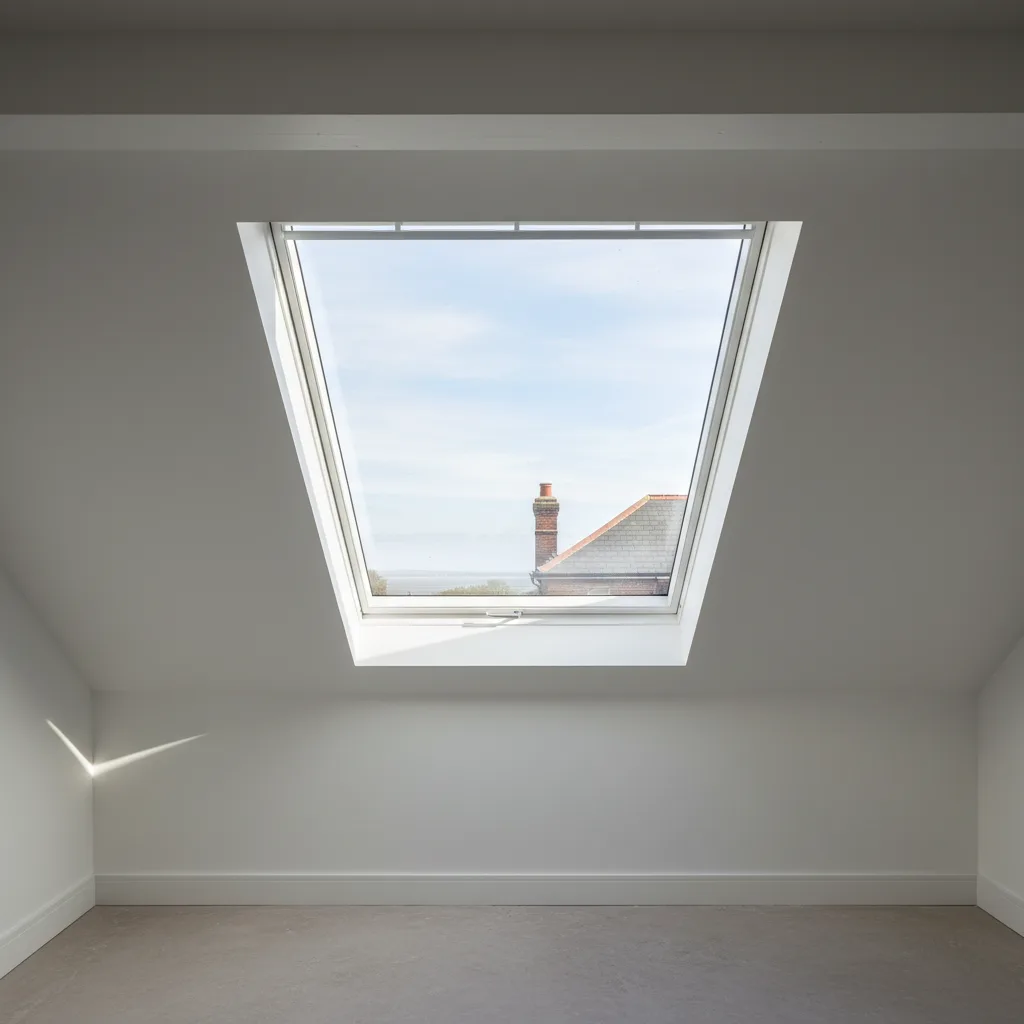
An opening rooflight does one job that a sealed pane cannot: it lets the hottest air in the house escape from the highest point in the room. How you make it open decides whether that happens twice a day by hand, on its own when the sun comes out, or at the touch of a switch. There are three ways to do it, they cost different amounts, they install differently, and one of them needs an electrician on site. Here is how they actually compare.
The three ways a rooflight opens
Strip away the marketing and there are exactly three opening methods on the market. A manual rooflight is worked by hand, either directly, with a pole, or through a geared winder. A solar-powered rooflight carries a small photovoltaic panel that charges an internal battery, and that battery drives a motor when you press a remote. A mains-powered rooflight is wired into the house electrics and driven by a motor that never runs out of charge.
All three move the sash the same way in the end. A chain or a spindle actuator pushes the glass open against its hinges and pulls it back down onto the seal. The difference is entirely in where the effort comes from: your arm, a battery topped up by daylight, or the ring main. That single choice ripples out into cost, into how much mess the installation makes, into whether the unit closes itself when it rains, and into how large a pane you can sensibly open at all.
The reason any of this matters more on a rooflight than on a wall window comes down to physics. Warm air rises and stacks up against the ceiling. A window at head height clears the middle of the room. An aperture in the roof sits above the warm layer and vents it straight out, which is why a single opening rooflight shifts stale, overheated air faster than two windows below it. Get the opening method wrong and you either never use it, or you cannot reach it, and an opening rooflight you never open is just an expensive sealed one.
Manual opening: poles, winders and spring assist
Manual is the oldest and cheapest route, and for a lot of rooms it is still the right one. There are three sub-types worth knowing apart.
A directly-handled rooflight has a handle on the frame that you reach and turn yourself. This only works where the glass is within arm’s reach, which on a standard ceiling means a low pitched slope in a loft room or a unit set into a coom ceiling you can stand next to. Get above about 2.2 metres to the handle and it stops being practical.
For anything higher, a telescopic pole is the usual answer. The pole clips into an eye on the sash and you wind or push the rooflight open from the floor. Poles come in rigid and telescopic forms and typically extend from around 1 metre to 3 metres, which covers most domestic ceiling heights up to the underside of a loft ridge. The catch is honest use: a pole that lives in a cupboard down the landing gets used in a heatwave and forgotten the rest of the year. If the rooflight is over a stairwell or a double-height space, the pole route becomes awkward enough that people simply stop bothering.
The third type is a geared winder or a spindle mechanism, where a crank handle at a reachable height turns a rod that drives the opener. These are common on conservatory-style roofs and on some heritage cast rooflights. They give good mechanical advantage, so a heavy sash opens with a light hand, but they add a visible rod and handle to the wall or frame.
Manual units are the least expensive to buy and the simplest to install, because there is nothing to wire and nothing to charge. They add nothing to the running cost of the house and there is no electronics to consider over the life of the unit. The whole case for manual is reach and habit: if you can get to it easily and you will actually use it, spend the money you saved on better glass instead.
Solar-powered opening: a panel, a battery and no wiring
Solar-powered opening is the option that surprises people, because it sounds like it should be feeble and it is not. A small photovoltaic panel, usually set discreetly into the top of the frame or the flashing, charges a rechargeable battery inside the unit. When you press the remote, the battery drives the motor. The panel does not power the motor directly and does not need to be in full sun to work: it trickle-charges the battery through daylight, including the diffuse light of an overcast day, and the battery holds enough to open and close the rooflight many times over between charges.
The headline advantage is that no cable runs to the rooflight. Nothing has to be chased into a ceiling, no fused spur has to be added, and no electrician is needed for the opening mechanism itself. That makes solar the natural choice for a retrofit, where a mains cable would mean lifting plasterboard, boarding, or insulation to feed a wire up to the roof. On a finished loft conversion or a replastered extension ceiling, avoiding that disruption is worth real money on its own.
Solar units almost always ship with a rain sensor and a remote control as standard, because the electronics are already there to support them. Touch the button and the sash swings open on its chain actuator; the first drops of rain hit the sensor and it closes itself, sealed, whether you are in the house or not. For a rooflight over a bed or over a kitchen you leave to nip out, that automatic close is the feature people end up valuing most.
The limits are worth stating plainly. The battery is a consumable and will need replacing at some point over the long life of the rooflight, typically many years in. The motor on a solar unit is sized for the battery, so there is a ceiling on how large and heavy a sash it will drive; very large panes and long strokes are better suited to mains. And the panel needs daylight to reach it, so a unit buried under a north-facing dormer cheek in permanent shade will charge more slowly than one on an open plane. On a south-facing roof over this stretch of the Essex coast, charging is rarely the problem.

Mains-powered opening: hardwired for the heavy work
A mains-powered rooflight is wired into the house electrics, usually off a fused spur, and driven by a motor that has as much power as you care to give it. This is the option for the big jobs: a large single pane, a run of linked units that all open together, a roof lantern where you want the whole thing to lift, or a high-level opener over a stairwell that will only ever be worked from a switch or an app.
Because the supply is constant, the motor can be stronger and faster than a battery-fed one, and it will drive a longer stroke and a heavier sash without complaint. There is no battery to replace and no charge to think about. Mains units integrate cleanly into home automation and lighting control, so a rooflight can be tied to a wall keypad, a timer, a thermostat, or a whole-house system that opens the roof when an internal temperature is reached and closes it at dusk. Group control is where mains earns its keep: three or four rooflights over an open-plan kitchen opening on one command is a mains job, not a battery one.
The cost of that capability is the wiring. A cable has to run from a fused spur to the rooflight, which on a new build or a ceiling that is still open is trivial, and on a finished room means chasing, lifting boards, or running trunking. That work needs a qualified electrician and it needs to comply with the wiring regulations, so it adds a trade and a cost to the installation that solar avoids entirely. If the ceiling is already up and undamaged, the disruption can outweigh the benefit unless the unit is genuinely too large for a battery motor.
Opening rooflights of this kind sit within our electric skylight installation work, where the glazing, the actuator and the control gear are specified together rather than bolted on afterwards. The point of specifying them as one is that the motor has to suit the weight of the glass, and on a south-facing roof the glass is often a heavy solar-control build-up, which is exactly the sort of sash that wants a mains motor behind it.
The three compared, side by side
These are industry-typical figures for domestic opening rooflights. Exact prices and strokes vary by manufacturer, by size and by how much wiring a given ceiling needs, so read them as the shape of the choice rather than a quotation. The pattern is what matters.
| Feature | Manual | Solar-powered | Mains-powered |
|---|---|---|---|
| Power source | Your arm, via pole or winder | PV panel charging an internal battery | Fused spur off the house electrics |
| Cable to the roof | None | None | Required |
| Electrician needed | No | No | Yes |
| Rain sensor | No | Standard on most units | Optional, usually fitted |
| Remote or switch | No | Remote handset | Wall switch, remote or app |
| Typical opening stroke | Limited by reach | Up to around 200mm | Up to around 400mm and beyond |
| Max practical sash size | Small to medium | Small to large | Large and linked runs |
| Consumable parts | None | Battery, replaced years in | None |
| Best retrofit case | Reachable units | Finished ceilings, no chasing | Open ceilings, big or grouped units |
| Typical cost over a sealed pane | Lowest | Adds roughly £300 to £600 | Motor plus wiring, often £400 upwards |
Read across the “electrician needed” row and the real divide appears. Manual and solar are both cable-free installations you can drop into a finished room without a second trade on site. Mains buys you power and grouping and app control, and it pays for them in wiring. Read the “typical opening stroke” row and the other divide appears: a battery motor opens a sash a useful amount, a mains motor opens it further and lifts more weight, which is the whole reason large lanterns and linked runs tend to be mains.
The cost figures are the part people most often misread. The gap between a manual unit and a solar one is not the price of a motor alone; it is the price of never touching a pole and of the rooflight closing itself in a downpour. Whether that is worth several hundred pounds depends entirely on how high the glass is and how forgetful the household is.
Rain sensors, remotes and automation
The opening method decides what control you can layer on top of it. A manual rooflight is manual: there is no sensor and no remote, and its great virtue is that there is nothing to fail. Both powered options open the door to automation, and this is often the deciding factor rather than the motor itself.
The rain sensor is the one feature almost everyone ends up wanting. A small sensor on the frame detects rain and closes the sash automatically, so an open rooflight over a bed, a landing or an unattended kitchen is never a risk. On solar units the sensor is nearly always included as standard. On mains units it is normally fitted and worth insisting on. There is no manual equivalent: a pole-operated rooflight left open in July is open until someone gets the pole out again.
Beyond rain, powered units accept timers, internal temperature triggers, wind sensors on exposed sites, and integration into a wider home system. A temperature trigger that opens the roof when a room passes a set figure and closes it when it drops back is genuinely useful on a south-facing extension that cooks in the afternoon and cools in the evening. Group control, where several rooflights answer one command, is a mains strength, though solar units from the same range can often be paired to a single remote as well.
One practical note on remotes: keep the handset somewhere permanent, because a lost remote for a high-level rooflight leaves you with no easy way to open it. It is a small thing that becomes a large annoyance over a two-storey stairwell.
Choosing for the room and the roof
The method follows the room, the reach and the aspect, in that order. Work down these and the answer usually names itself.
Reach first
If you can comfortably stand next to the rooflight and turn a handle, a manual unit is honest value and you should not talk yourself into a motor. If the glass is over a stairwell, a double-height space, a high coom ceiling or anywhere a pole becomes a chore, powered opening is not a luxury, it is the difference between a rooflight that gets used and one that does not.
Then the ceiling
If the ceiling is already finished, plastered and decorated, solar is the low-disruption choice, because it needs no cable chased through it. If the ceiling is open, whether that is a new build, a loft mid-conversion or an extension still at the wiring stage, running a mains cable is cheap while the boards are off, and mains becomes the sensible default for anything large.
Then the aspect
This is where a Southend roof changes the sums. The city faces south across the Thames Estuary, and the rear extensions and loft rooms across the surrounding south Essex housing stock, the enormous 1930s semi belt in particular, tend to put their glass on south-facing planes that collect solar gain all afternoon. A room like that overheats from the top down, and the fastest way to shed that heat is to open the rooflight at the ceiling and let the warm layer out. On a south-facing plane an opening unit is not just a nicety, it is the ventilation half of a specification whose other half is solar-control glazing. Glass controls what arrives through the roof; opening controls what leaves. A south-facing roof lantern or a run of flat-roof skylights over a knocked-through kitchen wants both, and the heavier solar-control glass on those planes is exactly the sort of weight that favours a mains motor. On a shaded north plane, where there is no afternoon build-up to clear, a manual or solar unit is usually plenty.
North-facing and lightly used rooms rarely justify mains. Landings, bathrooms and box rooms that just need a bit of air are natural homes for manual or solar. Save the wired motors and the grouped control for the rooms that genuinely overheat, which on this coast means the south and the west.
Retrofit, wiring and what to decide before you order
The single question that shapes the whole job is whether the ceiling is open or closed. Deciding the opening method after the plaster is on costs you the choice, because at that point a mains cable means damage and solar becomes the only cable-free powered route left. Deciding it before means you can run a cable for nothing while the boards are up, and keep every option open.
A few things are worth settling before you commit to a unit:
- How high is the glass, honestly? Measure the reach to the handle, not the floor-to-ceiling height. If you would need to fetch a pole, price a powered option.
- Is the ceiling finished or open? Open favours mains. Finished favours solar. This one fact settles most of it.
- How large and heavy is the sash? Large single panes, long strokes and linked runs point to a mains motor. A single modest rooflight is comfortably within a solar unit’s range.
- Do you want a rain sensor? If the answer is yes, and over a bed or an unattended room it usually is, you are choosing between solar and mains, not manual.
- Do you want grouped or automated control? Several units on one command, or opening on temperature, is mains territory, and it wants planning before the boards go on.
- Which way does the plane face? A south or west plane that overheats deserves an opener that gets used, which usually means a powered one. A cool north plane may not.
The same reasoning applies whether the unit sits in a flat roof, a pitched slope or a lantern, and whether it is a bespoke rooflight or a standard roof window from a known range. The opening method is a separate decision from the glass and the frame, and it should be made deliberately rather than defaulted to whatever the quote arrived with. New and enlarged rooflights are notifiable under Building Regulations, and where a powered unit is being wired in, the electrical work sits alongside the notification we make on your behalf.
If you are weighing these up for a specific roof, the sensible order is to match the glass to the aspect first, then choose the opener to suit the reach, the ceiling and the weight of that glass. Ask us for a specification that names the opening method for each rooflight, not just the units themselves, and you will know before you order whether you are buying a pole, a battery or a cable.
Related reading
How does an electric skylight work?
How does an electric skylight work? The short answer, then the detail that actually matters.
Wiring and power for an electric rooflight
Wiring and power for an electric rooflight. What it means in practice on Essex housing stock, and how we approach…
How much does an electric rooflight cost?
How much does an electric rooflight cost? The short answer, then the detail that actually matters.
Rain sensors and automatic closing
Rain sensors and automatic closing. What it means in practice on Essex housing stock, and how we approach it.
Do electric rooflights need an electrician?
Do electric rooflights need an electrician? The short answer, then the detail that actually matters.
Electric rooflights for stack ventilation
Electric rooflights for stack ventilation. What it means in practice on Essex housing stock, and how we approach it.