Servicing and access for a motorised unit
Servicing and access for a motorised unit. What it means in practice on Essex housing stock, and how we approach it.
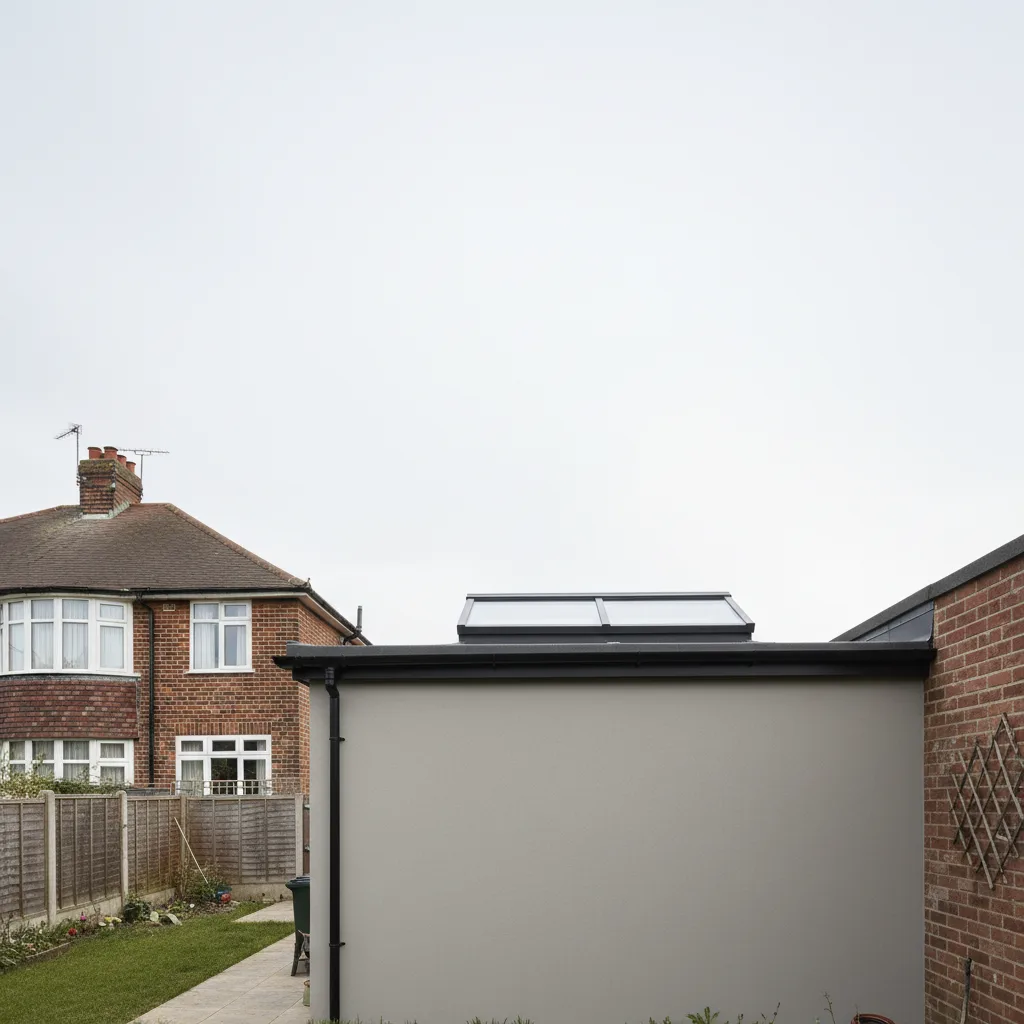
A motorised rooflight has three things a manual one does not: a motor, a control system, and a moving part sitting somewhere you probably cannot reach without a plan. Most of what keeps one working for twenty years is not clever, it is just access. If you can get to the glass, the hinges and the actuator without a scaffold every time, the unit gets looked after. If you cannot, it gets ignored until something stops moving. The time to solve that is before the frame goes in, not the first time the motor sticks.
What servicing a motorised unit actually covers
Servicing here means planned upkeep: cleaning, checking, lubricating and keeping the electronics happy. It is not a diagnostic guide for a dead motor, and it is not roofing work. A motorised rooflight is a mechanical assembly with a small electric drive bolted to it, and like any mechanism it lasts longest when it is kept clean and moving freely. Left alone on a roof for a decade, exposed to grit, pollen, salt and thermal movement, it will still work, but it will work harder and wear faster than one that gets ten minutes of attention twice a year.
Draw the line clearly. Cleaning the glass, wiping the seals, clearing the drainage channel and keeping the sensor lens clear are jobs a competent householder can do from the right platform. Anything involving mains wiring belongs to an electrician. Anything involving the roof structure, the flashing or the upstand belongs to a roofer. And a motor or control unit that has genuinely failed is not a servicing item at all: on a sealed opening rooflight the actuator and the glazed sash are usually supplied as one assembly, so a failed unit is replaced rather than taken apart on the roof. Replacing a worn-out opening rooflight with a new one is straightforward work. Trying to strip and rebuild an actuator forty feet up is not.
The moving parts and what each one needs
You cannot service what you do not understand, so start with what is actually up there. A motorised rooflight is a short list of components, each with its own failure mode and its own upkeep.
- The actuator. Either a chain drive, where a rigid chain pushes the sash open, or a spindle drive, where a threaded rod does the same job. Both are sealed for weather but both benefit from the sash moving freely, because a stiff hinge makes the motor strain against resistance every single cycle.
- The hinges and friction stays. These take the whole weight of a glazed sash, often 30 to 60 kilograms of it, and swing it through an arc twice a day. They are the part most improved by a wipe and a light lubricant, and the part most damaged by grit working into the pivot.
- The gaskets and compression seals. An opening rooflight seals by pulling the sash down onto a rubber gasket. That gasket has to stay clean, supple and unbroken. Grit sitting on it means the sash never quite closes flat, which lets water track in and lets warm air leak out.
- The drainage channel. Around the frame is a small gutter that collects the water that gets past the outer line and sheds it back outside. Leaves, moss and pollen block it. A blocked channel is the single most common reason a perfectly good rooflight starts letting water in.
- The rain and wind sensors. A small sensor on the frame tells the unit to close automatically when it rains or when the wind gets up. Its lens needs to stay clean or it stops reading correctly.
- The control unit and power. A low-voltage controller, mains or battery fed, plus whatever wall switch, remote or home system drives it. No moving parts, but pairing and batteries need occasional attention.
Designing access in before the unit goes in
This is the part that gets skipped, and it is the part that decides everything that follows. Access to a rooflight is set the moment its position is chosen, and it is far cheaper to solve on a drawing than on a finished ceiling. A motorised unit exists precisely because it sits where a person cannot easily reach a handle, so by definition it is going somewhere awkward.
Three positions cause the trouble. The first is a high flat ceiling over a large open-plan kitchen, common on the single-storey rear extensions across the south Essex semi belt, where the glass can be three or four metres up. The second is a stairwell or a double-height void, where the rooflight is above open space with no floor beneath it to stand a ladder on. The third is a steep pitched slope, where the outside face of the glass is over a drop and reaching it from the roof needs proper equipment.
For each of these, the questions to settle at survey are the same. How will the glass be cleaned from inside and from outside? If the motor ever needs replacing, how does a person and a new unit get up to it? Is there a clear route to run a maintenance pole, or somewhere to stand a small tower? On a double-height void, is there a landing or a gantry point, or will every future visit need a tower built off the floor below? None of this is exotic. It is the difference between a rooflight you glance at twice a year and one you never touch because touching it is a half-day operation.
A maintenance schedule you can actually keep
Upkeep only happens if it is simple enough to happen. The tasks below are the whole of it for a domestic motorised rooflight. Nothing here needs a specialist for the mechanical side, though anything electrical should wait for an electrician.
| Task | Interval | Why |
|---|---|---|
| Clean the glass, inside and out | 2 to 4 times a year | Grime cuts daylight and, on a rain sensor unit, can confuse the sensor |
| Wipe the compression gasket with a damp cloth | Twice a year | Grit on the seal stops the sash closing flat |
| Clear the drainage channel around the frame | Twice a year, autumn essential | A blocked channel is the top cause of water tracking in |
| Clean the rain and wind sensor lens | Twice a year | A dirty sensor reads wrong and may close the unit needlessly |
| Light lubricant on the hinge pivots and stays | Once a year | A free-moving sash means the motor works easy, not hard |
| Run the unit fully open and closed, watch and listen | Every few months | Catches a stiffening hinge or a straining motor early |
| Check and replace the backup battery | Every 2 to 4 years | Backup only helps if it holds charge; most give a warning near the end |
| Confirm remotes and any home-system pairing | Yearly, or after a power loss | Controls occasionally drop their link and need re-pairing |
The single most useful habit on that list is the cheapest: cycle the unit fully open and shut every few months and pay attention to how it sounds. A motor that has started to strain, or a sash that judders on the way up, is telling you a hinge is drying out or grit has found the pivot. Ten minutes with a cloth and a light lubricant then saves the motor from months of fighting resistance. The rooflights that give trouble are almost never the ones that get run and watched. They are the ones nobody has opened since the summer before last.
Reaching the glass and the actuator: access methods compared
How you reach a rooflight depends entirely on how high it is and what is under it. There is no single answer, and matching the method to the height is what keeps upkeep safe and cheap. The figures below are reach guides for the common domestic options.
| Access method | Working reach | Best for | Watch out for |
|---|---|---|---|
| Telescopic cleaning pole and pad | Glass up to about 4m | Routine glass and sensor cleaning from the floor below | Cleans only; no good for the mechanism or a swap |
| Step ladder | Ceilings up to about 3m | Standard-height flat ceilings with a solid floor beneath | Never over a stairwell or open void |
| Small mobile access tower | Platform up to 4 to 6m | High kitchen ceilings and double-height rooms | Needs floor space and a level, load-bearing base |
| Bespoke tower or gantry off a landing | Set to the void | Stairwell and full double-height voids | Plan the standing point at design stage |
| Roof access with harness and anchor | Outer face on a pitch | Cleaning and unit replacement from outside | Roof and fall-protection work, not a householder job |
A telescopic pole handles the routine outside-and-inside cleaning on the great majority of domestic units, and it costs almost nothing. The problems begin when a motor reaches the end of its life and the glazed sash has to come out. That is a two-person job with a heavy unit at height, and on a void it needs a proper working platform. Knowing at the outset whether that platform is a tower off a solid floor or a purpose-built gantry off a landing turns a future replacement from a headache into an afternoon. This is one of the reasons an electric rooflight installation is worth planning as a whole, access and all, rather than treating the motor as a bolt-on to a standard opening.
Rain and wind sensors, and why Southend’s aspect matters
The sensor is the part of a motorised unit most affected by where you are, and Southend is a demanding place to put one. The city faces south across the open Thames Estuary, so its roofs get an unobstructed run of wind straight off the water, and that wind carries salt. Both facts change how the sensors need looking after.
Wind matters because a wind sensor is what protects an open sash from being caught and strained in a gust. On the exposed roofs along the seafront and the cliff top, that sensor earns its keep more often than it would inland, and it needs a working backup so it can drive the unit shut even if the mains drops during the same squall that raised the wind. Salt matters because it settles on the sensor lens and on the hinges, and a salt film reads as grime to an optical rain sensor. That is why the twice-a-year sensor clean is not optional on a coastal roof: a lens crusted with estuary salt will either miss real rain or, more often, keep closing the unit on a clear day.
There is a solar-gain reason a lot of these units are motorised in the first place, and it is the reason the venting has to keep working. South Essex has an enormous stock of 1930s semis with knocked-through, glazed rear extensions facing south into the garden. A roof lantern or a run of flat-roof skylights over a room like that is collecting solar energy all afternoon, and the hottest air stratifies at the top of the room, right against the glass. A motorised opening rooflight vents that stratified layer out through the highest point, which is exactly where a hand-cranked pole is least likely to reach twice a day. So on a south-facing extension the motor is not a luxury, it is what makes the summer venting actually happen. If you want the glass to fight the heat as well as the opening to release it, that is where solar-control glazing comes in alongside the motor, and the two are specified together. A sensor that has stopped venting because nobody cleaned it hands the room straight back to the afternoon sun.
Power, batteries and keeping the controls talking
The electrical side of a motorised unit is low maintenance, but it has a few points that reward attention. Units run either from a mains-fed low-voltage supply through a control unit, or, in some retrofits, from a rechargeable battery topped up by a small solar panel on the frame. Each has upkeep implications.
On a mains unit, the item to keep an eye on is the backup battery inside the controller. Its whole purpose is to close the rooflight if the power fails while the sash is open, so a flat backup on a rainy, windy evening is the one scenario you least want. Most controllers flag a failing backup with a warning light or a beep, and a two to four year replacement cycle keeps ahead of it. On a solar-battery unit, the panel needs to stay clean for the same reason the glass does, and the battery itself has a finite life measured in years rather than decades. Neither is difficult, both just need to be on the list.
The other electrical quirk is pairing. Wireless remotes, wall switches and any smart-home integration hold a link to the control unit, and that link occasionally drops, usually after a power loss or a battery change. Re-pairing takes a couple of minutes with the instructions, but it is worth doing deliberately once a year and always after the power has been off, so you are not discovering a lost remote in the middle of a downpour. Keep the paperwork that came with the unit somewhere findable, because the pairing sequence is model-specific and impossible to guess. If the mains supply itself is ever in doubt, that is an electrician’s job and not a servicing one.
When a motorised unit reaches the end of its road
Nothing mechanical lasts forever, and a motorised rooflight has more to go wrong than a non-opening one. A well-kept unit will typically give fifteen to twenty years of daily cycling before the actuator or the sealed glazing tires, sometimes longer, and the ones that reach the top of that range are almost always the ones that got the twice-a-year clean and the annual hinge lubricant. When a sealed opening unit does reach the end, the actuator and the glazed sash are one assembly, so the sensible course is to replace the unit rather than attempt to rebuild a mechanism at height.
Replacing a worn motorised rooflight with a new one is proper installation work: the old unit out, the upstand and flashing checked, a current-specification unit fitted and made weathertight, with the Building Control notification handled as part of the job. It is also the moment to reconsider the glass. Rooflight glazing has moved on across a fifteen-year life, and a south-facing unit that went in with clear double glazing can be replaced with a solar-control specification that keeps the daylight and takes out most of the summer heat, or upgraded to a quieter, better-sealed named-brand opening unit with a longer-lived actuator. If you are weighing up whether an ageing motor is worth persevering with or better replaced, ask us to survey it and put the options in front of you, access included, so you can decide with the numbers rather than guessing from the ceiling.
Related reading
How does an electric skylight work?
How does an electric skylight work? The short answer, then the detail that actually matters.
Wiring and power for an electric rooflight
Wiring and power for an electric rooflight. What it means in practice on Essex housing stock, and how we approach…
How much does an electric rooflight cost?
How much does an electric rooflight cost? The short answer, then the detail that actually matters.
Rain sensors and automatic closing
Rain sensors and automatic closing. What it means in practice on Essex housing stock, and how we approach it.
Do electric rooflights need an electrician?
Do electric rooflights need an electrician? The short answer, then the detail that actually matters.
Electric rooflights for stack ventilation
Electric rooflights for stack ventilation. What it means in practice on Essex housing stock, and how we approach it.