VELUX blinds, awnings and shading
VELUX blinds, awnings and shading. What it means in practice on Essex housing stock, and how we approach it.
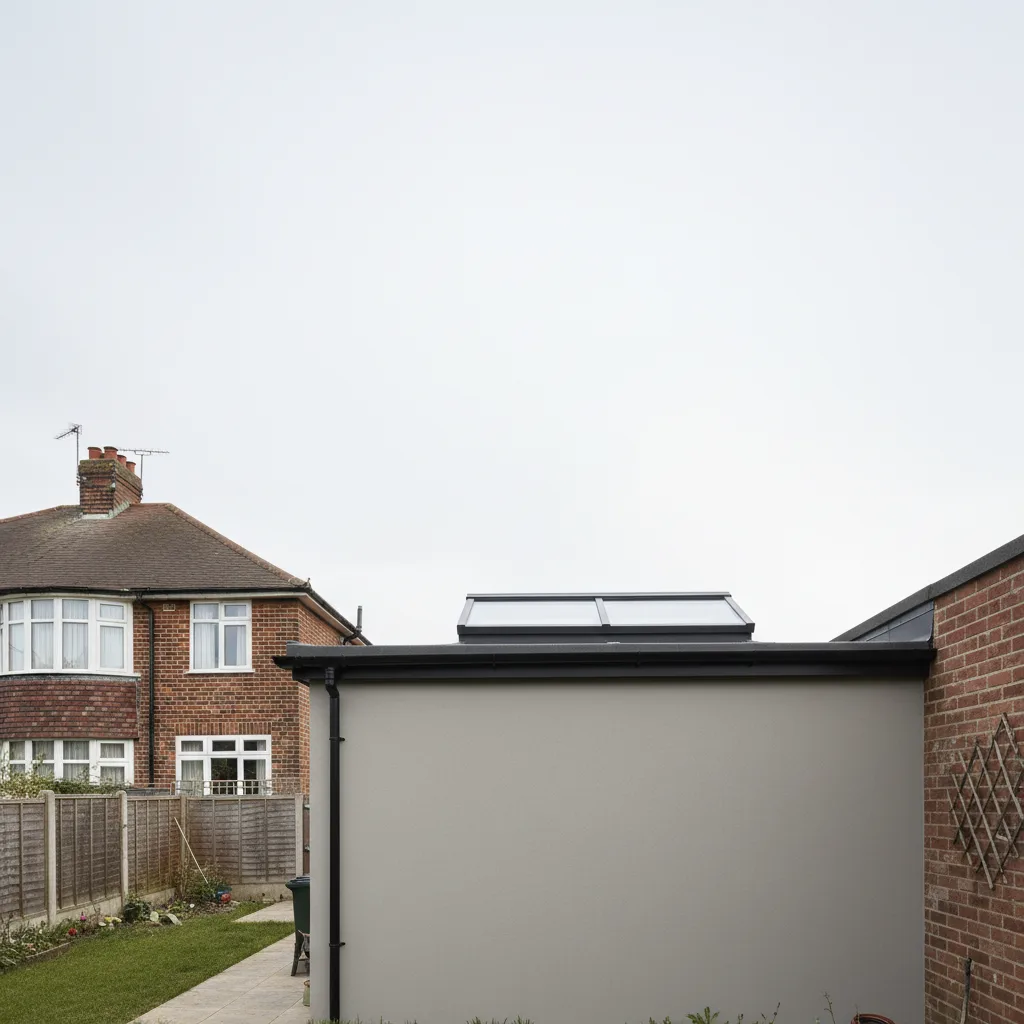
A VELUX window is a hole in your roof filled with glass, and glass lets the sun in whether you want it to or not. Shading is how you take that decision back. The choice people usually agonise over is the fabric and the colour. The choice that actually governs the temperature of the room is whether the shade sits on the inside of the glass or the outside of it, because that single fact decides how much of the July sun ever reaches you.
Inside the glass or outside it: where shading works
Start with the physics, because it settles most of the argument before you ever open a swatch book. Sunlight arriving at a roof window is energy. Once that energy passes through the pane it is inside your room, and it stays inside as heat. An interior blind hangs below the glass, so by the time it intercepts the light, the energy is already through. The blind absorbs it, warms up, and re-radiates a good share of that warmth back into the room. It stops the glare and it dims the brightness, but the heat has mostly already been delivered.
An exterior shade does the opposite. It sits above the glass, out in the open air, and it blocks the sun before the pane ever sees it. The heat it absorbs is carried away by the breeze rather than trapped against your ceiling. This is why an awning blind on the outside can take out something in the region of three-quarters of the solar heat, while an interior blackout blind on the same window handles far less of it even though it looks completely dark from below.
The way to think about it is the G-value, the proportion of the sun’s energy that gets through into the room. Solar-control glass lowers that figure by reflecting the near-infrared at the pane. An exterior awning does the same job mechanically, dropping the effective G-value of the whole opening the moment it is deployed. An interior blind barely moves it. If you only remember one thing from this page, remember that shade on the outside changes the temperature and shade on the inside changes the light.
The VELUX interior blind range
VELUX makes a factory-fitted blind for almost every purpose, and each type is designed to clip straight onto the window frame with no drilling into the joinery. They come in coded families. You do not have to memorise the codes, but knowing what each one is for saves a lot of wasted money.
| Blind type | What it does with light | Thermal effect | Best suited to |
|---|---|---|---|
| Blackout (DKL family) | Blocks the light almost entirely, side channels seal the edges | Modest. Slows heat loss slightly in winter | Bedrooms, nurseries, home cinemas, shift workers |
| Roller (RFL family) | Dims and softens, does not fully darken | Small | Living rooms and kitchens wanting privacy without full black |
| Pleated (FHL family) | Diffuses the light into a soft even glow | Small | Landings, studies, awkward shaped windows |
| Energy pleated, honeycomb (FHC family) | Filters the light, translucent | Best of the interior options. The honeycomb traps a layer of air | Rooms where you want a little winter insulation as well as shade |
| Venetian (PAL family) | Tilts to aim or bounce the light, fully adjustable | Small | Bathrooms, offices, anywhere you want to steer daylight |
| Roman (FML family) | Filters light, fabric look | Small | Rooms where the finish matters as much as the function |
Read that thermal column carefully. Every interior blind here is doing a small job on temperature and a large job on light, glare and privacy. That is not a criticism, it is what they are for. A blackout blind in a south-facing loft bedroom is the right product for getting a child to sleep at half past eight on a June evening when the sky is still bright. It is the wrong product for keeping that same bedroom below 26 degrees at bedtime. Those are two different problems, and the blackout blind solves one of them.
The honeycomb energy blind is the interior type that does most for comfort, because the trapped air pocket in the pleats adds a thin insulating layer against the glass. It takes a little of the edge off winter heat loss and a little off summer gain. It is still an interior product, so the summer effect is limited, but among the indoor options it is the one that earns its place on thermal grounds rather than purely decorative ones.
Awning blinds: exterior shading that targets solar gain
The awning blind is the product this business gets most animated about, because it is the one that actually addresses the problem south Essex roofs have. It is a fine mesh screen, usually black or a dark grey, that rolls down over the outside of the glass on a pair of side arms. You see out through it almost as if it were not there, the view stays open, and yet it removes a large fraction of the solar energy before it can enter.
The mesh works because it shades and cools at the same time. It is out in the moving air, so the heat it collects is swept away rather than stored. The open weave keeps your outward view and a usable level of daylight, which is the part people do not expect. You are not sitting in the dark. You are sitting in a room that has stopped heating up.
Typical figures for exterior mesh shading run in the region of a 70 to 90 per cent reduction in the solar heat that would otherwise come through the glass, depending on the openness of the weave and the colour. Put that against an interior blackout blind, which might handle a fifth to a quarter of the heat, and the gap is enormous. On a large south-facing roof window over a kitchen, that difference is felt as several degrees on the hottest afternoons.
Awning blinds pair naturally with an opening roof window. Shade the glass on the outside, open the window at the top of the room, and you get the two things a hot roof space needs at once: less heat arriving and a route for the heat already there to escape upwards. If you are already planning roof windows on a south-facing slope, specifying the awning at the same time is far tidier than retrofitting one later.
Roller shutters: blackout, shading and quiet
A roller shutter is the heavier exterior option. It is a solid slatted screen, aluminium with an insulating core, that rolls down over the outside of the window in a guide rail on each side. Where the awning is a mesh you see through, the shutter is a barrier you close.
It does several things a blind cannot. Fully down, it gives total blackout, darker than any interior blind because no light leaks around the edges. It cuts the solar gain even harder than an awning, because it is opaque and sits outside the glass. It adds a genuine layer of insulation for winter nights, since the closed slats trap a pocket of air against the pane and lift the effective U-value of the opening. It knocks down noise, which matters under the flight paths and busier roads across the patch, and it dulls the drum of heavy rain on the glass that some people find keeps them awake. Left partly down, it also acts as adjustable shade rather than all-or-nothing.
The trade is that a shutter, fully closed, shuts out the daylight and the view along with the heat. It is a device for controlling a room at particular times rather than a permanent softening of the light. Many people fit it on a bedroom for the blackout and the winter insulation, and use it as summer shading as a bonus. On a west-facing room that bakes in the late afternoon, dropping the shutter halfway from four o’clock is a straightforward way to hold the temperature without losing the whole evening.
Choosing shading by which way the roof faces
Southend faces south across the Thames Estuary, which is unusual for an English seaside city and is the whole reason shading is a bigger question here than it is inland. A south-facing roof plane with an open horizon over the water collects sun through more of the day and more of the year than a plane that faces into a hillside or a row of houses. So the aspect of the roof, not the size of the window, should drive the shading decision.
Here is how the compass points map onto product choice.
- South-facing planes. This is exterior shading territory. An awning blind, a shutter, or solar-control glass with an awning over it. The sun is high and strong here from late morning onwards in summer, and an interior blind alone will not hold the room. The rear extensions and loft conversions on the 1930s semis that fill this area, with south-facing gardens, are the classic case.
- West-facing planes. Underrated and often the worst of the lot. The low late-afternoon sun strikes a west slope at a shallow, direct angle just as the house has finished soaking up heat all day. Treat west much like south: exterior shade or a partial shutter for the four-to-seven window.
- East-facing planes. Strong morning sun, but the room has all day to recover and most houses are empty or want the warmth then. An interior roller or a mid-range awning is usually enough.
- North-facing planes. No direct beam to control at all. Here you want light, not shade. A simple interior blind for privacy or blackout is all that is called for, and heavy exterior shading would just steal daylight you paid for.
The point that ties it together is that a house often has windows on more than one plane, and they should not all get the same treatment. The north-facing landing window and the south-facing kitchen lantern have opposite problems, and giving them the same blind gets one of them wrong. Working out the aspect of each opening before choosing anything is the same discipline behind our approach to solar-control glazing, and shading is the moving-parts version of the same idea.
Manual, solar-powered or mains: how they open
Every VELUX blind, awning and shutter comes in more than one method of operation, and the choice matters more on a roof than it does on a wall, because a roof window is often out of arm’s reach.
- Manual. A handle at the bottom of the window, or a control rod for higher openings. Cheapest, nothing to power, nothing to fail. Fine on a window you can reach standing on the floor.
- Solar-powered. A small photovoltaic cell on the window frame charges a battery, and the blind runs off that. No wiring at all, which means no chasing cables through a finished ceiling. This is the option that makes most sense as a retrofit onto windows you already have, and it is the one most people choose for out-of-reach roof windows in a room that is already decorated.
- Electric, mains-wired. Wired back to the mains, controlled from a wall switch or a remote. Worth doing when the ceiling is open anyway during a loft conversion or an extension, so the cable can be run before the plasterboard goes up.
Solar and electric units respond to a remote control, and they can be grouped so a whole run of roof windows shades in one press. On a high ceiling this is the difference between a shade that actually gets used and one that sits open all summer because nobody fancies the ladder. The same reasoning drives our advice on powered opening windows: if reaching it is a chore, the automation is not a luxury, it is what makes the thing work day to day.
Getting the size and code right
VELUX blinds are made to fit specific window sizes, and the size is stamped on a data plate on the window itself, usually on the top bar visible when you open the sash. It is a two-character code, a letter and a number, such as MK04 or SK06. Order the blind to that code and it clips straight on. Order to a measured guess and it will not seat properly in the side channels, which is where a blackout blind earns its darkness.
A few things worth knowing before you buy.
- The size code changes with the generation of the window. An older window and a current one of the same nominal dimensions can carry different codes, so read the actual plate rather than assuming.
- Awning blinds and shutters mount to the exterior frame and, on some older windows, need a bracket or an adaptor. This is easy to sort on a survey and awkward to discover after ordering.
- Colour and fabric are the last decision, not the first. Settle whether the job is heat, glare, blackout or privacy, pick the product type that does that job, then choose how it looks.
- Exterior products face the weather, so the fit and the mounting matter more than they do on an indoor blind. This is the part of a shading job where getting the installation right pays off, on a coast that sees its share of wind off the estuary.
If your roof windows are being replaced or newly installed, the cleanest route is to specify the shading as part of that work rather than as a separate exercise later. Our VELUX window installation service handles the window and its shading together, so the exterior brackets, the wiring for any powered units and the size codes are all sorted in one go rather than reverse-engineered afterwards.
Where shading stops and glass and ventilation take over
Shading is one of three levers on a hot roof room, and it works best when it is not asked to do the whole job alone. The other two are the glass specification and the ventilation, and a room that overheats badly usually needs all three pulling together.
The glass is the permanent, always-on part. Solar-control glazing lowers the G-value of the window for its whole life with nothing to deploy and nothing to remember. Shading is the adjustable part on top of it: you drop it when the sun is on the glass and lift it when it is not, so you keep the free winter warmth that the glass lets through in December while cutting the July peak. Pairing solar-control glass on a south plane with an exterior awning gives you a floor and a ceiling on the heat, which is about as much control as a roof window can offer.
Ventilation is the escape route. Shade decides how much heat arrives, ventilation decides how much leaves. An opening roof window sits at the top of the room where the hottest air collects, so it clears a stuffy loft far faster than any window at head height. Shade the glass, open the top, and the room both takes in less and sheds more. Leave the window shut and even good shading will let a room drift warm over a long hot spell, because there is nowhere for the heat that does get in to go.
None of this is a reason to be nervous about putting glass in a roof. It is a reason to specify the whole thing for the aspect: the glass for the plane it sits on, the shading for the times the sun is on it, and an opening for the heat to leave by. We have been installing roof windows and skylights across south Essex for over fifteen years, every installation backed by a ten-year workmanship guarantee, and shading is treated as part of the specification rather than an accessory bolted on at the end. If you want shading worked out plane by plane for your own roof, alongside the glass and the ventilation, ask us for a specification and we will set it out for each window rather than across the whole roof at once.
Related reading
How do I find my VELUX product code?
How do I find my VELUX product code? The short answer, then the detail that actually matters.
Reading a VELUX size code and finding your product code
Reading a VELUX size code and finding your product code. What it means in practice on Essex housing stock, and…
How much does a VELUX window cost to install?
How much does a VELUX window cost to install? The short answer, then the detail that actually matters.
VELUX centre-pivot and top-hung compared
VELUX centre-pivot and top-hung compared. What it means in practice on Essex housing stock, and how we approach it.
VELUX flashing kits for tile and slate
VELUX flashing kits for tile and slate. What it means in practice on Essex housing stock, and how we approach…
What are the standard VELUX sizes?
What are the standard VELUX sizes? The short answer, then the detail that actually matters.