Non-fragile rooflights and roof safety
Non-fragile rooflights and roof safety. What it means in practice on Essex housing stock, and how we approach it.
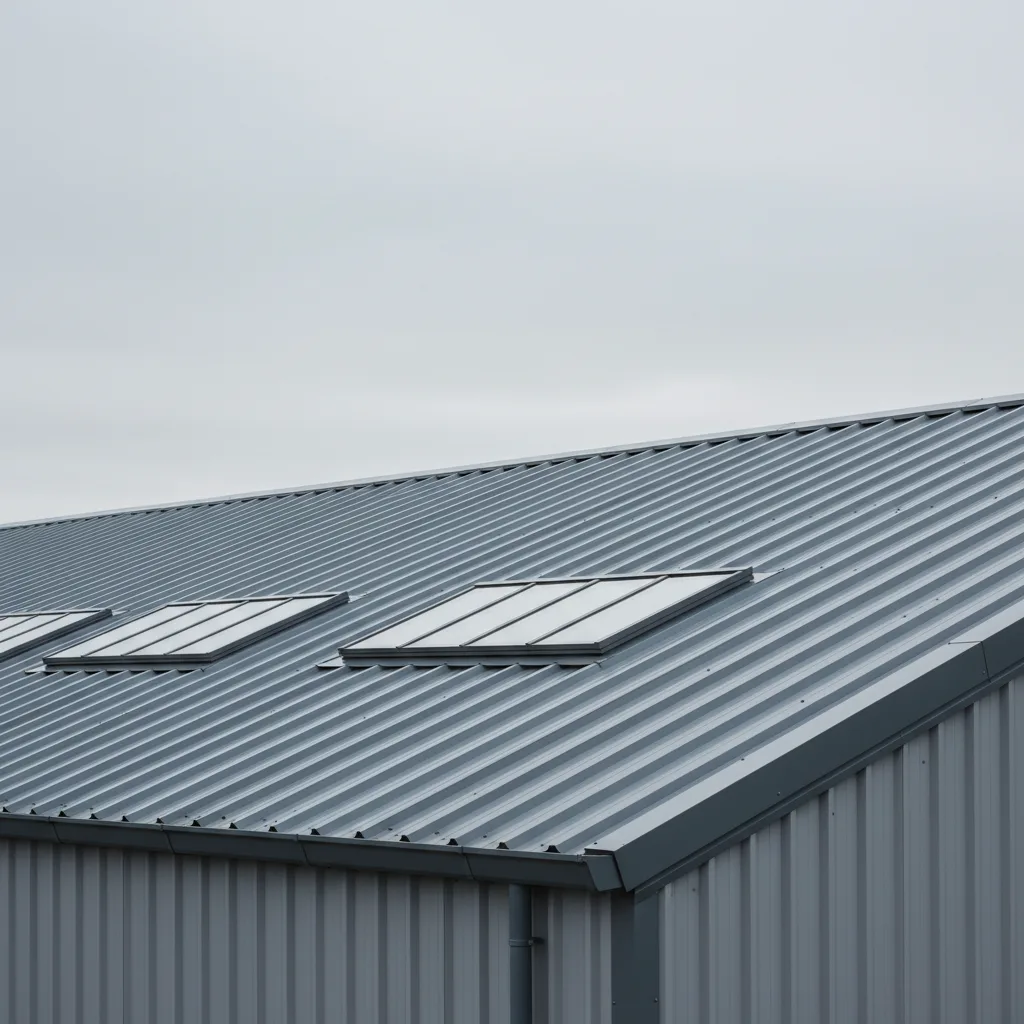
From above, a fragile rooflight looks exactly like a solid one. Same profile, same colour once the years have dulled it, sitting flush in the sheeting where a maintenance worker expects a walkable surface. That is the whole danger. A person steps back to reach a flue, puts a heel on what they read as roof, and the panel gives way. Falls through fragile rooflights are one of the longest-standing killers in commercial roofing, and the answer is a specification decision made before anyone ever gets on the roof.
What makes a rooflight fragile
Fragility is not about whether something feels solid underfoot on a warm afternoon. It is about whether an assembly will hold a person who lands on it by accident. In roofing terms a surface is fragile if it will not reliably support the weight of a falling worker plus the tools they carry, applied suddenly rather than gently. A rooflight can carry a light snow load, shrug off hail for twenty years and still be fragile, because none of that tests it the way a falling body does.
Several things push a rooflight into the fragile category. Thin single-skin glassfibre, the corrugated translucent sheet common on older industrial and agricultural roofs, is fragile from the day it is fitted. Wired glass, still found in mid-century commercial buildings, cracks and drops through despite the wire. Single-skin polycarbonate is often fragile depending on thickness and fixing. And plenty of assemblies that started life sound have crossed into fragile territory through age alone, which is the part most owners miss.
The word that matters in the standards is assembly. A rooflight is not just a pane. It is the sheet or the glass unit, the frame or upstand it sits in, the fixings, and the way it meets the surrounding roof. Non-fragility is a property of that whole build-up working together, not of the glazing on its own, and that is why a like-for-like panel swap without regard to the frame and fixings can quietly leave you no safer than before.
Why falls through rooflights are a roof-safety problem, not a glazing footnote
Work on and around roofs is governed by the Work at Height Regulations 2005, which place a duty on whoever controls the work to plan it, assess the risk and prevent falls so far as is reasonably practicable. Fragile surfaces get their own specific mention because they cause a share of construction deaths out of all proportion to how often people work near them. The Health and Safety Executive has treated falls through fragile roofs and rooflights as a priority hazard for decades, and its guidance is blunt: assume every rooflight is fragile until proven otherwise.
The people at risk are rarely the ones who commissioned the building. They are the cleaners, the solar-panel fitters, the aerial engineers, the gutter clearers and the surveyors who come along years later, walk a flat commercial roof, and have no way of knowing which translucent panels will hold and which will not. A rooflight that has faded to the same tone as the metal deck around it becomes invisible as a hazard. That is why a good specification does not stop at the glazing figure. It carries a duty forward to everyone who will ever set foot up there.
How non-fragility is tested and classified
You cannot judge non-fragility by eye or by standing on something. It is decided by a physical drop test set out in ACR[M]001, the industry test method published by the Advisory Committee for Roof Safety and known on site as the red book test. The principle is simple. A soft-body impactor weighing 45kg, chosen to represent a falling worker, is dropped onto the rooflight assembly from a set height. The assembly is watched to see whether the body passes through.
An assembly that arrests the impactor and does not let it fall through is classed as non-fragile, the Class B designation under the standard. One that lets the body through is fragile and fails. The test is done on a full assembly, mounted and fixed the way it would be on a real roof, because a panel that passes loose on a bench can still tear out of a weak frame in service. A responsible manufacturer will hold a current test certificate for the exact build-up they are selling you, and will state the classification in writing.
Two points are easy to misread. First, non-fragile is a pass or fail outcome for the tested assembly, not a strength score you can compare like a horsepower figure. Second, and more important, the classification describes the assembly as tested when new. It says nothing about how that same panel will behave after fifteen summers on a south-facing roof, which brings us to the part of the subject that catches building owners out.
Age is the enemy: how a non-fragile rooflight turns fragile
Non-fragility is not a permanent property. It is a starting condition that degrades, and the main agent of that degradation is ultraviolet light. Polymers used in translucent roofing, glassfibre and polycarbonate among them, lose toughness as UV breaks down the resin and the surface. A panel that comfortably passed the drop test on the day it was made can, after enough sun, shatter under a load it once held.
This is why the trade works to a rule of thumb: a rooflight that has been in place for a couple of decades should be treated as fragile regardless of what it was when new, unless there is current evidence otherwise. Many manufacturers put a stated non-fragile design life on their assemblies, often in the region of ten to fifteen years, after which the non-fragile assurance lapses and the panel is assumed fragile again. A roof full of original translucent sheets from the 1980s or 1990s is, for planning purposes, a roof full of fragile openings.
South-facing commercial roofs age fastest, because they collect the most UV. A large warehouse or workshop roof pitched or laid towards the south takes more solar exposure across its life than an identical roof facing north, so its rooflights embrittle sooner. That is the same aspect that drives solar gain and glare inside the building, and it is worth keeping both problems in view when the panels come up for replacement, because the same survey answers both.
Specifying non-fragile rooflights on a replacement
When old translucent panels reach the point where they are assumed fragile, replacing the assembly with a currently tested non-fragile build-up is the clean answer. It removes the hazard at source, and it is our work: a failed or time-expired rooflight taken out and a new, certified assembly installed in its place, with the frame and fixings specified to match. The alternative, leaving fragile panels in and relying forever on temporary covers and edge protection whenever anyone goes up, is a cost that never ends and a risk that never fully closes.
The table below sets out the common assembly types and how they stand up on fragility. Treat the figures as the shape of the market rather than a quote, because thickness, fixing pattern and frame all move the result.
| Assembly type | Fragility when new | How it ages | Typical use |
|---|---|---|---|
| Single-skin GRP sheet | Fragile | Embrittles and delaminates | Old industrial and agricultural roofs |
| Wired glass | Fragile | Cracks and drops through | Mid-century commercial buildings |
| Twin-skin polycarbonate, older | Sometimes non-fragile | Loses non-fragile status with UV | Rooflights fitted 15 or more years ago |
| Triple-skin polycarbonate to ACR[M]001 | Non-fragile, Class B | Design life stated by maker | Modern flat and low-pitch commercial roofs |
| Multiwall polycarbonate barrel vault, tested | Non-fragile, Class B | Design life stated by maker | Large-span workshop and retail roofs |
| Double-glazed unit, laminated inner pane | Non-fragile if specified so | Very stable, glass does not embrittle | Flat commercial rooflights and lanterns |
Two things carry across every row. The laminated inner pane matters because, in a glass unit overhead, the laminate holds the broken glass in its interlayer rather than letting it fall through, and it is what turns a glass rooflight into a non-fragile one. And the certificate has to describe the assembly you are actually buying, not a cousin of it. A polycarbonate rooflight is only as non-fragile as its skins, its thickness and its frame together, so the specification names all three.
Non-fragile is not the same as walkable
This is the distinction that saves lives and the one most people get wrong. A non-fragile rooflight is designed to arrest a person who falls onto it by accident and to hold them long enough to be reached and recovered. It is not a floor. It is not rated for someone to stand on deliberately, walk across, wheel a barrow over or park plant on, and doing any of those things can damage it and quietly destroy its non-fragile status for the next person.
So even a roof fully re-glazed with certified non-fragile assemblies still needs a safe system for anyone working up there. That means keeping people away from rooflights where the task allows, marking panel positions so nobody mistakes glazing for deck, and providing proper access, edge protection and, where needed, guarding around openings for planned maintenance. Non-fragility is the last line of defence, the thing that catches the mistake nobody meant to make. It is not a substitute for not making the mistake.
Building Regulations reinforce the point from the other direction. Part K covers protection from falling and the use of safety glazing, and any glass fitted overhead has to be specified with that in mind. A non-fragile assembly and Part K compliant glazing are related ideas pointing the same way: the glass above people’s heads has to fail safe.
Roof safety during a commercial installation
Replacing rooflights on a live commercial building is work at height on, quite literally, the most fragile part of the roof, so the safety plan is not an afterthought bolted to the quote. It is the reason a job is sequenced the way it is. On any project of a size where design and construction are coordinated in advance, the duties under the Construction (Design and Management) Regulations 2015 apply, and the openings left when old panels come out are treated as fall risks in their own right until the new assembly is fixed and proven.
In practice that means the working area is protected before a single panel is disturbed, openings are never left uncovered and unattended, materials are handled so nobody is tempted to lean over a void, and the finished installation is left with its non-fragile assembly properly seated and its upstand watertight. The point of doing it this way is not paperwork. It is that the person exposed to the fall during the change-over is the installer, and the plan exists so that they come down the same way they went up. Every commercial rooflight installation we carry out is notified to Building Control, so the glazing specification, including the non-fragile assembly and the thermal performance, is set down on paper and stands up to inspection.
If what you actually have is a single cracked or storm-holed panel and the rest of the roof is sound and recent, a roofer working to a proper access plan may be the right first call to make the roof safe. Where the panels are time-expired across the roof, or fragile by age, replacing the assemblies is the durable answer rather than covering the same openings again and again.
South Essex commercial stock and what to specify
South Essex has a large stock of the exact buildings where this matters. The industrial estates around Basildon, the trade units and warehouses along the arterial roads, the workshops and retail sheds inland from the seafront, and the older light-industrial ranges near the port edge at Thurrock all tend to carry long runs of translucent rooflight across metal-deck or asbestos-era roofs. A good share of that glazing is original, which means a good share of it should be treated as fragile until a current certificate says otherwise.
The estuary aspect adds the local twist. Southend and the coastal strip face south across the Thames Estuary, so commercial roofs here that pitch or lay towards the south take a heavy UV dose across their life and embrittle their rooflights faster than an inland roof of the same age. That same south aspect drives heat and glare into the space below through those very panels. When the fragile panels come up for replacement, it is the moment to solve both problems at once: a certified non-fragile assembly for safety, specified with a solar-control glass or a tinted polycarbonate solar-control specification for the summer heat, on the planes that actually face the sun. A survey that reads the compass across the roof lets the non-fragile and the thermal choice be made plane by plane rather than blanket-specified across the lot.
The through-line for any commercial building owner is short. Assume old rooflights are fragile. Replace time-expired assemblies with currently certified non-fragile ones rather than managing the hazard forever. Keep a safe system for maintenance even after you have, because non-fragile is a catch, not a floor. And on a south-facing roof, let the same replacement do double duty on solar gain. If you want the fragility status and the glazing figures set out for your own roof, plane by plane, ask us for a specification before anyone else goes up there.
Related reading
What is a non-fragile rooflight?
What is a non-fragile rooflight? The short answer, then the detail that actually matters.
GRP rooflight replacement on an industrial roof
GRP rooflight replacement on an industrial roof. What it means in practice on Essex housing stock, and how we approach…
How much does commercial rooflight replacement cost?
How much does commercial rooflight replacement cost? The short answer, then the detail that actually matters.
Barrel vault and northlight rooflights
Barrel vault and northlight rooflights. What it means in practice on Essex housing stock, and how we approach it.
How often should industrial rooflights be replaced?
How often should industrial rooflights be replaced? The short answer, then the detail that actually matters.
Can rooflights be replaced without stripping the roof?
Can rooflights be replaced without stripping the roof? The short answer, then the detail that actually matters.