Rain sensors and automatic closing
Rain sensors and automatic closing. What it means in practice on Essex housing stock, and how we approach it.
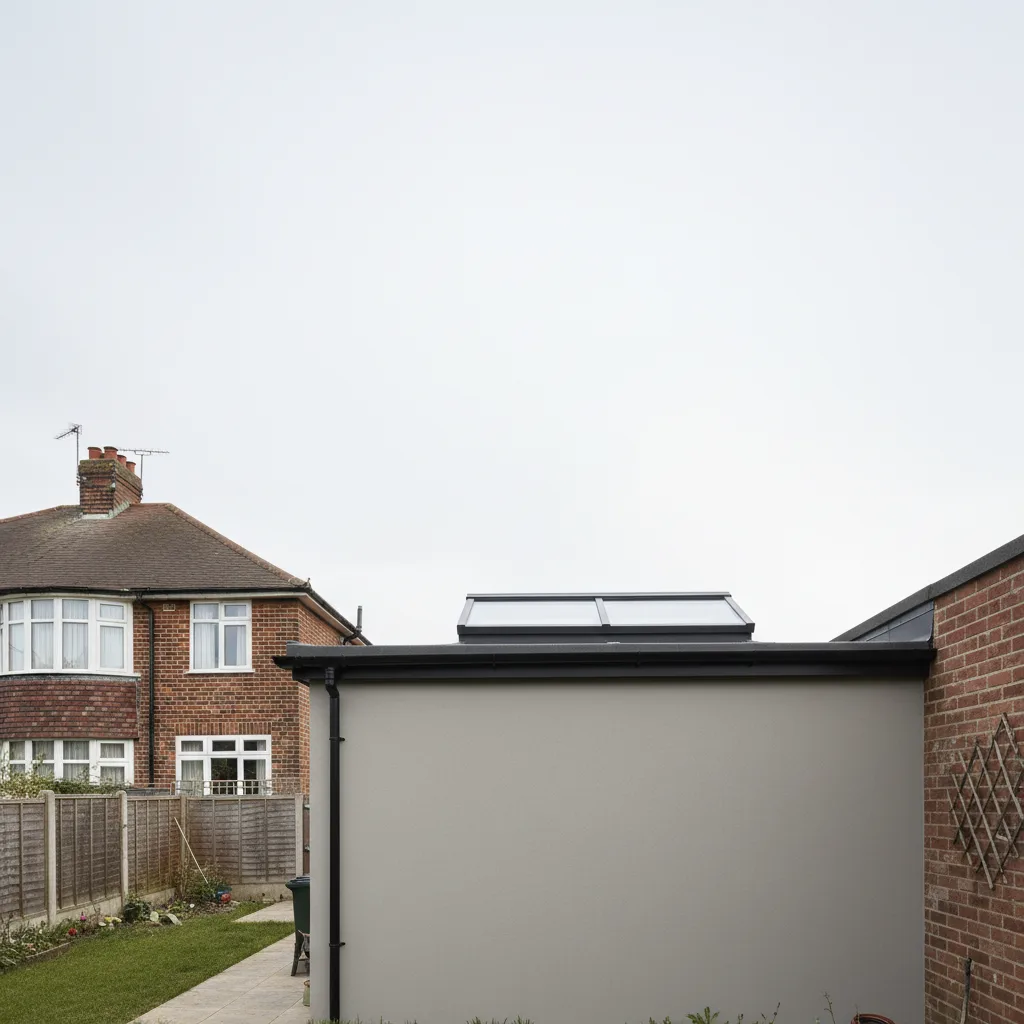
An opening rooflight that you leave ajar for the afternoon is only useful if it shuts itself before the weather turns. That is the whole job of a rain sensor: it watches the glass for the first drops and drives the light closed on its own, whether you are in the garden, at work or asleep. It sounds like a small feature. On a flat or shallow roof over a room full of furniture, it is the difference between a vent you actually use and one you never dare open.
What a rain sensor is and how it decides it is raining
A rain sensor is a small electronic pad, usually two or three centimetres across, mounted near the rooflight or on the frame itself. Its top surface carries a fine grid of two interlaced metal tracks that do not touch each other. Dry, the gap between the tracks is an open circuit and no current flows. The moment a drop of water bridges the gap, it conducts a tiny current across it, the control unit registers the change and it sends the close command to the motor.
Most sensors of this type also carry a low-power heating element under the pad. The heater does two things. It keeps frost and dew from tripping the sensor on a cold clear morning when there is no actual rain, and it evaporates the water quickly once the shower has passed so the light does not sit closed for an hour after the last drop. Without the heater, a single splash of overnight condensation could keep a rooflight shut all day.
There is a second design worth knowing about. Some systems use an optical or capacitive sensor rather than a conductive grid. An optical sensor shines infrared light through a small prism and measures how much bounces back; water on the surface changes the reflection and the reading drops. A capacitive sensor measures the change in an electric field as water sits on it. These are less common on domestic rooflights than the simple heated conductive pad, but they resist dirt and salt build-up better, which matters in an exposed coastal position.
Whichever type it is, the sensor is a switch, not a rain gauge. It knows wet from dry. It does not measure how hard it is raining, and for closing a rooflight it does not need to. The instruction is binary: water present, shut the light.
The gap between the first drop and the closed seal
The part people underestimate is time. A rain sensor does not close a rooflight instantly, and it cannot, because a chain or spindle motor has to wind the sash through its full travel. On a typical domestic opening rooflight the sequence runs like this.
| Stage | Typical time | What is happening |
|---|---|---|
| Drop lands, sensor trips | Under 1 second | Water bridges the sensor grid, control unit registers wet |
| Command sent to motor | 1 to 2 seconds | Controller confirms the reading and energises the actuator |
| Sash travels to closed | 20 to 40 seconds | Chain or spindle winds the light through its full opening |
| Seal compresses | 2 to 5 seconds | Motor drives past first contact to compress the gasket |
So from first drop to weathertight seal you are looking at roughly half a minute to a minute, depending on how far the light was open and how fast the actuator runs. In a light shower that is neat and quick. In a sudden hard downpour, which the Essex coast gets its share of when a summer front comes through off the estuary, a small amount of water can get in during that closing window. It is rarely enough to matter over a tiled floor. Over a solid oak table, a laptop or a bed directly under the aperture, it is worth thinking about where the light sits before you rely on the sensor as your only defence.
Two things shorten the exposure. A faster actuator, and a control unit that closes to a rain-safe position first rather than winding all the way from full open every time. Some systems, if you open the light for ventilation on a showery day, will only crack it to a small vent so the closing travel is short. That is a setting worth asking about rather than assuming.
What the closing motor actually is
Automatic closing needs a motor, and there are two common kinds on rooflights. Knowing which one you have tells you how it behaves.
Chain actuators
A chain actuator pushes a rigid, articulated chain out of a housing on the frame to lever the sash open, then winds it back in to close. The chain is straight under load but folds away inside the unit. Chain actuators are compact, quiet and well suited to top-hung and centre-pivot rooflights. A single chain gives a stroke of around 200 to 400 millimetres, which is plenty for ventilation. They typically draw 24 volts and pull a couple of amps while running, so they run off a low-voltage transformer, not mains at the sash.
Spindle and rack actuators
A spindle actuator turns a threaded rod that drives a nut along its length, extending or retracting an arm. These give a longer, more powerful stroke and are used on larger rooflights, roof lanterns with an opening vent and commercial units where the glass is heavy. They are slower than a chain of the same reach but they hold position firmly and cope with wind load on a big sash.
Both types close under their own power on the rain command. Neither relies on a spring or on gravity, which is important on a rooflight: gravity would try to hold a top-hung light open, not shut it. The motor drives the sash positively into the seal and holds it there. When the sensor dries out and clears the rain signal, the light does not reopen on its own. Reopening is a separate command, either from you or from a temperature or timer rule, so you never get a rooflight flapping open and shut through a squally afternoon.
Where rain closing fits with the rest of the automation
A rain sensor is rarely the only automatic input on a well set-up opening rooflight. It usually sits alongside two others, and the priority order between them matters.
- Rain. Closes the light. Highest priority on most systems, because water ingress is the thing you most want to prevent.
- Wind. An anemometer or a wind threshold in the controller closes the light in a gale to protect the sash and the actuator from being loaded beyond their rating. On an exposed roof this earns its place.
- Temperature. A thermostat opens the light for cooling once a room passes a set temperature, and closes it again as the room cools. This is the input that makes an opening rooflight useful for summer heat rather than just for fresh air.
The sensible logic is that safety inputs override comfort inputs. If the temperature rule wants the light open for cooling but the rain sensor is wet, rain wins and the light stays shut. Once the rain clears and the sensor dries, the temperature rule is allowed to take over again. Good controllers handle this hierarchy for you. Cheaper ones sometimes fight themselves, opening on heat and closing on the residual damp of the last shower in an annoying loop, which is another reason the heated sensor pad matters: it clears the wet signal quickly and lets the comfort logic resume.
This is also where automatic opening ties back to the reason people fit rooflights over south-facing rooms in the first place. A south-facing extension or loft in Southend collects a great deal of solar energy through the afternoon, and even with solar-control glazing holding the incoming heat down, warm air still stratifies and pools against the ceiling. An opening rooflight at the highest point of the room lets that hot layer escape far more effectively than a window at head height. A temperature-triggered vent that clears the stratified heat, backed by a rain sensor so it can be left to its own devices, is what makes the strategy work when nobody is home to manage it by hand.
What a rain sensor will not do for you
It is worth being clear about the edges of what the feature covers, because a few of them catch people out.
It does not detect condensation on the inside of the glass. The sensor is on the outside, watching for rain from the sky. Interior condensation is a U-value and ventilation matter, not something the rain sensor sees or responds to.
It does not close a manually latched light. If your rooflight has a mechanical spar handle that you have wound open by hand, an electric rain sensor has nothing to drive; automatic closing only works on a motorised unit. This is one of the practical reasons to choose a powered opening light rather than a manual one on any rooflight you cannot easily reach.
It does not guarantee a dry floor in a cloudburst. As the timing table shows, there is a closing window of half a minute or so during which a hard shower can throw a little water through the gap. The sensor massively reduces the risk compared with leaving a light open unattended, but it is a fast responder, not a force field.
It does not run without power. A rain sensor and its actuator need their low-voltage supply. In a power cut, a light that was open stays open, and one that was closed stays closed. Some higher-specification controllers carry a small battery backup that will drive the light to closed on loss of mains, which on an exposed coastal roof is a sensible thing to specify rather than assume.
And it does not maintain itself. The pad collects dust, pollen, salt film and the general grime of an outdoor surface. A conductive sensor caked in a layer of salt can either trip falsely or, worse, fail to trip because the crust insulates the grid. Wiping the pad clean once or twice a year keeps it honest. That is a homeowner task, not a trade one.
Why this matters more on a Southend roof
Every point above applies anywhere, but a few of them bite harder on the south Essex coast, and it is worth naming why.
The estuary exposure means wind and salt. A roof on the cliff top at Leigh or along the Southend seafront sits in clean open air with the wind coming off the water, which is good for drying the sensor quickly but hard on the hardware. Salt-laden air leaves a film on every horizontal surface, and the rain sensor is a horizontal surface with a job to do. This is the setting where an optical or capacitive sensor, which does not rely on bare conductive tracks, tends to hold up better than the basic grid, and where the once-a-year wipe is not optional.
The south aspect means the automatic opening gets used hard. Because Southend faces south across the estuary, its south-facing rear extensions and loft slopes take a full afternoon of sun with an open horizon and reflected light off the water on top. Those are exactly the rooms where a temperature-triggered opening rooflight does the most work, venting stratified heat that even good glass cannot stop from building up against the ceiling. The more the automatic opening runs for cooling, the more often the rain sensor is the thing standing between an open vent and a shower. It is not a bolt-on feature on these roofs. It is what lets you leave the cooling vent to look after itself.
The housing stock means a lot of flat and shallow roofs. The 1930s semi belt across the patch, and the single-storey rear extensions bolted onto it, are full of flat and low-pitch roofs over kitchens and dining spaces. A flat rooflight faces straight up, so rain lands on it squarely and an open one is directly exposed to whatever falls. That geometry is the same reason a flat rooflight collects so much solar gain, and it is why the pairing of good glass, an opening vent and a reliable rain sensor tends to end up on the same roof. If your opening light sits over a flat-roof extension, the rain sensor is doing more for you than it would on a steep slope where the run-off is quicker and the exposure lower.
Choosing and specifying: what to ask for
You can settle the sensible questions in one conversation with whoever is specifying the rooflight. The list is short.
- Is the sensor heated? A heated pad clears dew, frost and the last of a shower quickly so the light does not sit needlessly shut. On a coastal roof, insist on it.
- Conductive, optical or capacitive? For an exposed salt-air position, the non-contact types resist grime and give fewer false readings over the years.
- How fast does the actuator close, and from what position? A faster close and a rain-safe part-open vent setting both shrink the window during which water can get in.
- Is there a wind input as well? On the cliff top and the seafront, a wind threshold that closes the light in a gale protects the actuator and the sash. Ask whether the controller supports one.
- What happens in a power cut? Find out whether the light fails open or closed, and whether battery backup to drive it shut is available. On an unattended roof this is worth the extra.
- Can the rain rule override the temperature rule cleanly? The controller should let rain win over cooling without hunting back and forth. A well designed system does this without you thinking about it.
- Who wires and notifies it? A motorised rooflight is a new opening rooflight and is notifiable under Building Regulations. We make that notification to Southend-on-Sea City Council, or the relevant local authority for your address, as part of the installation.
None of this makes a rain sensor an expensive feature. As industry-typical guidance, the sensor and its wiring add a modest amount to the cost of an already-electric opening rooflight, on the order of a hundred pounds or so of parts and integration rather than a major upgrade, because the motor and controller are already there. The value is not in the component. It is in what it lets you do with the light: leave it open on a warm, uncertain day and trust it to look after itself. You can see how the powered opening side of this fits the wider picture on our guide to electric and opening rooflights, and if you want a specification worked out for a particular roof, including which rooms genuinely benefit from an automatic cooling vent, ask us for one.
Living with an automatic rooflight day to day
Once it is in and set up, the point of the whole arrangement is that you stop thinking about it. A few habits keep it that way.
Set the temperature threshold to a figure that suits the room rather than leaving it at the factory default. A kitchen with an oven running tolerates more heat before you want the vent open than a home office with screens, where glare and warmth both spoil the afternoon. The opening trigger is yours to tune.
Learn the manual override. Every good controller lets you take charge by hand, close the light before a party or open it on a still night the thermostat would not have bothered with. Automatic is the default, not a cage.
Give the sensor its annual wipe when you are cleaning the glass, and while you are up there, check that nothing has grown across it, no moss, no leaf litter, no bird mess. A blocked sensor is the single most common reason one of these systems appears to have stopped working, and a damp cloth sorts it in two minutes.
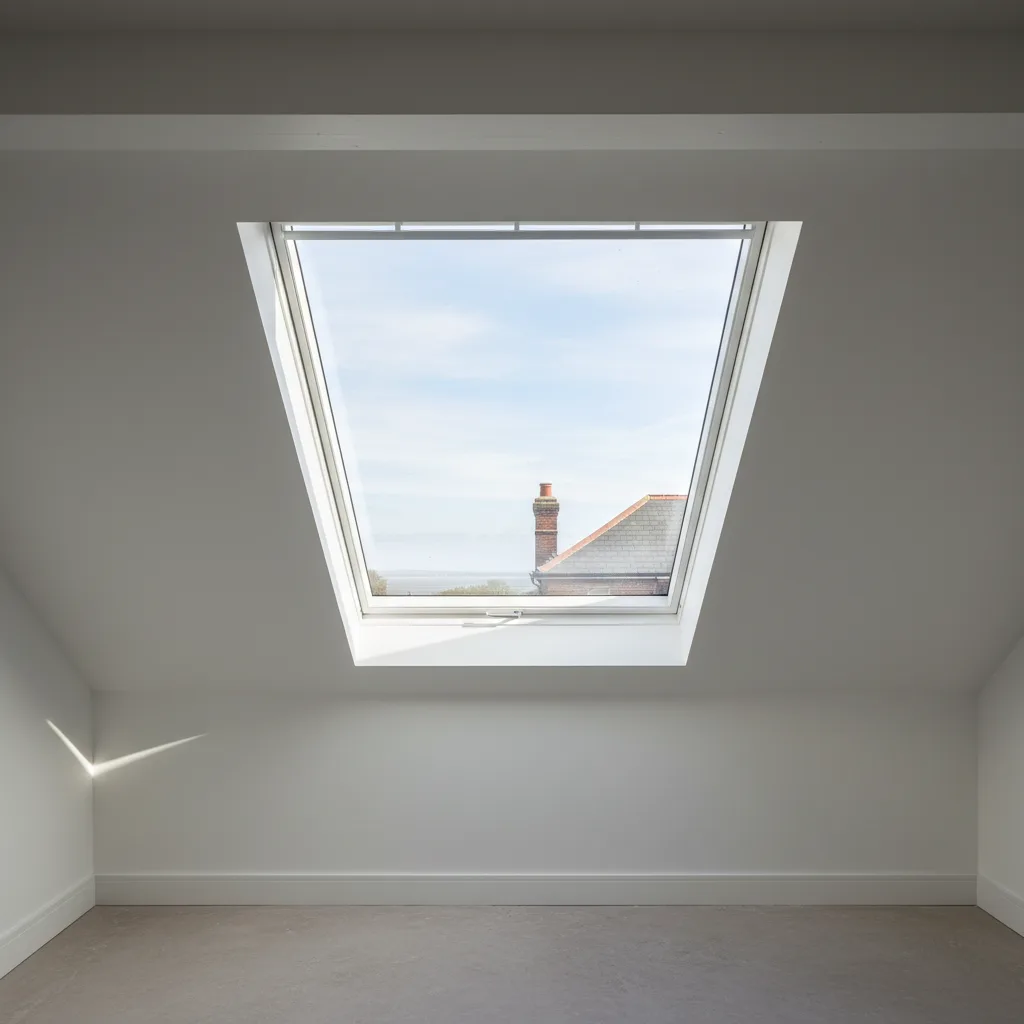
Think about the room, not just the light. The rain sensor protects the aperture, but on a south-facing roof the reason you opened the light in the first place is heat, and the opening vent works best in partnership with the glass rather than instead of it. A vent clears the hot air that has already arrived; the right glass stops so much of it arriving. Getting both right is what turns a bright room that overheats every July afternoon into one you can sit in at four o’clock without drawing a blind, and the rain sensor is the small, quiet part that lets the opening half of that do its job while you get on with your day.
Related reading
How does an electric skylight work?
How does an electric skylight work? The short answer, then the detail that actually matters.
Wiring and power for an electric rooflight
Wiring and power for an electric rooflight. What it means in practice on Essex housing stock, and how we approach…
How much does an electric rooflight cost?
How much does an electric rooflight cost? The short answer, then the detail that actually matters.
Do electric rooflights need an electrician?
Do electric rooflights need an electrician? The short answer, then the detail that actually matters.
Electric rooflights for stack ventilation
Electric rooflights for stack ventilation. What it means in practice on Essex housing stock, and how we approach it.
Chain, spindle and linear actuators compared
Chain, spindle and linear actuators compared. What it means in practice on Essex housing stock, and how we approach it.