Are commercial rooflights insulated?
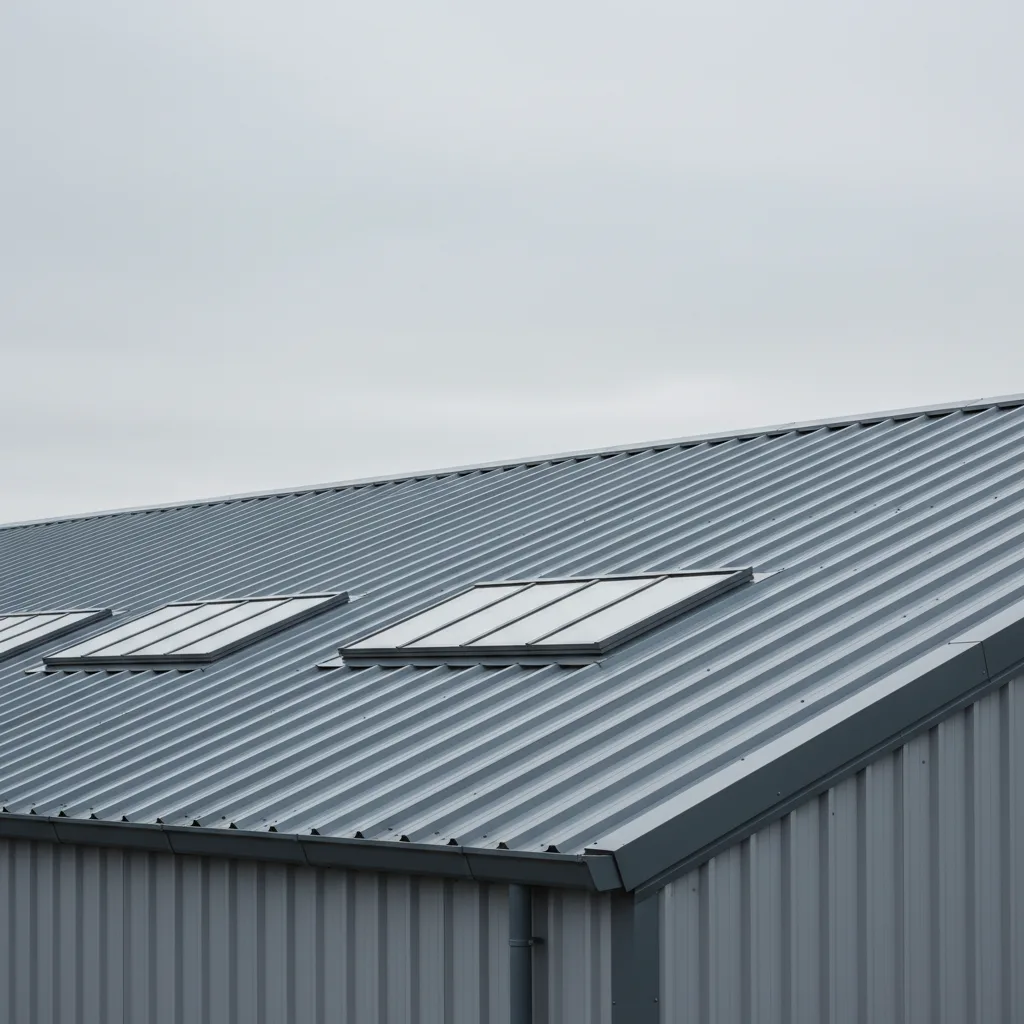
Any commercial rooflight specified and fitted to current standards is insulated, because a new or replacement rooflight on a non-domestic building has to meet a thermal performance limit under Building Regulations before it is signed off. What varies is how well: a twin-wall polycarbonate dome and a triple-glazed sealed unit are both “insulated”, yet one can lose heat two or three times faster than the other, so the useful question is not whether a unit is insulated but what its whole-unit U-value actually is and where the insulation is being lost around it.
What “insulated” means for a rooflight, and the number that proves it
Insulation in a rooflight is measured as a U-value, in watts per square metre per degree of temperature difference, written W/m²K. It tells you how fast heat escapes through the unit on a cold night. A lower number is better. Single-skin rooflights, the clear or opal sheets you still see on older warehouses and lean-to roofs, sit up around 5 W/m²K and behave like a hole in the insulation. A modern sealed unit can get down towards 0.8 W/m²K, which is close to what a good flat roof build-up manages.
The figure that matters on a commercial job is the whole-unit U-value, not the centre-pane one. Centre-pane describes the glazing on its own, away from the edges. Whole-unit averages that glazing with the frame and the upstand it sits on, so it reads higher, and it is the honest measure of what the finished rooflight does on the roof. When a supplier quotes you a very low number, check which one it is, because comparing one product’s centre-pane figure against another’s whole-unit figure will send you towards the wrong unit.
For most non-domestic buildings the thermal limit comes from Part L2 of the Building Regulations, which sets a ceiling on the U-value of a new or replaced rooflight. A unit that clears that limit is, by definition, insulated to the current standard. That is the floor, though, not the target. On a heated office or a school hall you will usually want to specify well below the limit rather than scrape over it.
The glazing options, and where each one lands
Commercial rooflights come in two broad families, and they insulate very differently.
| Rooflight type | Typical whole-unit U-value | Where it fits |
|---|---|---|
| Single-skin GRP or polycarbonate | Around 5.0 | Unheated stores and canopies only. Not compliant as a new rooflight over heated space. |
| Twin or triple-wall polycarbonate | Around 2.5 to 1.5 | Warehouses, workshops and large industrial roofs where light and cost matter more than a very low U-value. |
| Multi-wall polycarbonate, five wall and up | Around 1.5 to 1.0 | Better-insulated industrial and retail units wanting daylight without a heat penalty. |
| Double-glazed sealed unit | Around 1.6 to 1.1 | Offices, schools, healthcare and anywhere the ceiling is on show and clarity is wanted. |
| Triple-glazed sealed unit | Around 1.0 to 0.8 | Low-energy buildings and heated spaces directly under the glass. |
Polycarbonate insulates by trapping air between thin walls, so more walls means a lower U-value, at the cost of a slightly milkier view of the sky. Sealed glass units insulate with a gas-filled cavity and low-emissivity coatings, and they stay clear. The two are not rivals so much as answers to different briefs. A distribution shed wants cheap even daylight across a big area, and multi-wall polycarbonate does that. A meeting room with an exposed ceiling wants a crisp view upwards, and a coated glass unit does that.
The upstand is where the insulation is won or lost
A rooflight does not sit flat on a commercial roof. It sits on a kerb, or upstand, a raised frame that lifts the glazing clear of standing water and lets the roof covering turn up behind it. That upstand is part of the thermal picture, and it is where a lot of otherwise good units leak heat.
An uninsulated metal or timber kerb is a thermal bridge: a direct path for heat to travel from the warm inside to the cold outside, going around the clever glazing entirely. On a cold morning that cold ring of kerb is also the first surface where warm indoor air will drop condensation, which is why a rooflight with a perfect glazing spec can still drip if the upstand was left bare. A builder’s kerb formed in plywood and felt is common on older commercial roofs and does little thermally. A proprietary insulated GRP or composite kerb carries insulation up the sides and keeps the warm line continuous from the roof deck to the frame.
So when you are told a commercial rooflight is insulated, ask about the kerb as well as the glazing. The two numbers only add up to a warm, dry rooflight if both are handled. Getting the upstand right is a large part of what a proper commercial skylight installation covers, and it is worth more to the finished result than another wall of polycarbonate.
South-facing commercial roofs: insulation is only half the job
Insulation stops heat leaving in winter. It does very little to stop heat arriving in summer, and on a south-facing commercial roof that second problem is often the bigger one. This is the point most rooflight specifications miss.
Along the Thames Estuary, where the ground faces south towards open water, a rooflight collects sun from mid-morning until late afternoon across the whole cooling season. The measure for that is not the U-value but the G-value, the proportion of the sun’s energy the unit lets through as heat. Clear glazing sits around 0.6, letting most of that energy in; a solar-control unit can be nearer 0.3. On a large flat commercial roof the glazing points at the sky rather than at any compass direction, so it takes the high summer sun almost square on regardless of which way the building is turned. Put a wide run of clear rooflights over an open-plan office facing south and you build a very well-insulated room that overheats every July, with staff reaching for portable cooling and the daylight benefit lost.
The way to handle it is to specify the U-value and the G-value together, so the roof keeps heat in during winter and turns the worst of it away in summer. That balance is the heart of our energy-efficient skylight installation work, and it applies whether the unit is new or replacing a failed one on an existing opening.
What to specify, and what to do next
Ask any supplier for three figures on the same build-up: the whole-unit U-value, the G-value, and the light transmittance. A phrase like “thermally broken” or “high performance” is not a number and does not tell you what the unit does. Then match those figures to the building. A heated, occupied space wants a low U-value and, if it faces south or the glazing is horizontal, a low G-value to go with it. An unheated store can take a simpler, cheaper unit.
Confirm the kerb is insulated, not just the glass, and confirm the unit is being fitted to current Building Regulations, including Part L for thermal performance and Part K for safety glazing where people can walk beneath it. New and enlarged rooflights on a non-domestic building are notifiable, and the notification is part of the job, not an afterthought.
If you would rather hand that over, tell us the building type, the roof orientation and the rough opening sizes, and we will come back with a glazing and kerb specification and a price. Ring 01702 898232 or request a quote, and we will look at how the whole roof performs in both seasons rather than just the units going in it. If your existing rooflights are being taken out anyway, the swap is the moment to put the glass and the upstand right at the same time on a flat roof skylight installation.
Related reading
Non-fragile rooflights and roof safety
Non-fragile rooflights and roof safety. What it means in practice on Essex housing stock, and how we approach it.
What is a non-fragile rooflight?
What is a non-fragile rooflight? The short answer, then the detail that actually matters.
GRP rooflight replacement on an industrial roof
GRP rooflight replacement on an industrial roof. What it means in practice on Essex housing stock, and how we approach…
How much does commercial rooflight replacement cost?
How much does commercial rooflight replacement cost? The short answer, then the detail that actually matters.
Barrel vault and northlight rooflights
Barrel vault and northlight rooflights. What it means in practice on Essex housing stock, and how we approach it.
How often should industrial rooflights be replaced?
How often should industrial rooflights be replaced? The short answer, then the detail that actually matters.