Retrofitting shading to an existing rooflight
Retrofitting shading to an existing rooflight. What it means in practice on Essex housing stock, and how we approach it.
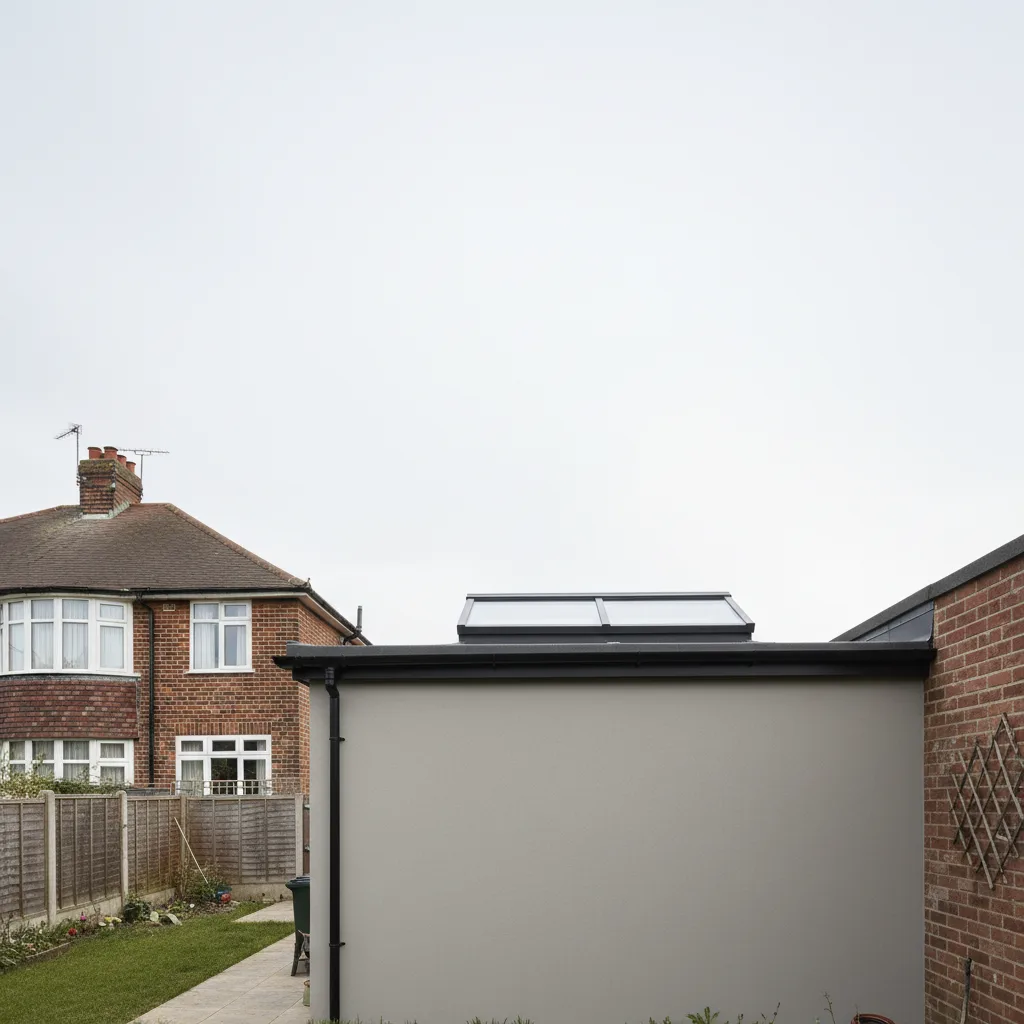
A rooflight that overheats in summer does not always need replacing. Sometimes the glass is fine and the room simply needs something between the sun and the pane. Retrofit shading is that something. But where you put it matters more than what you spend on it, because a blind on the inside and a blind on the outside are doing two completely different jobs, and only one of them stops the heat before it becomes your problem.
Inside the glass or outside it: the one decision that changes everything
Solar energy that reaches your rooflight has two ways of ending up in the room. It can pass straight through the glass as light and near-infrared, or it can be absorbed by whatever it strikes and then given off again as warmth. Shading works by intercepting that energy. The question is whether it intercepts it before or after the glass.
Put a blind on the outside and it catches the sun while the energy is still airborne. Anything the fabric absorbs heats up outside, in free air, and most of that warmth is carried away on the breeze before it can reach the pane. Only a small share is left to conduct inwards. External shading can knock the effective solar heat gain down by around three quarters, sometimes more, because it is working on the right side of the barrier.
Put the same blind on the inside and the sun has already crossed the glass before the fabric ever sees it. The energy is now indoors. The blind absorbs it, warms up, and re-radiates that heat into the space it is meant to be protecting. An internal blind is genuinely useful for glare, for privacy and for blackout, and a light-coloured reflective one will send some energy back out through the glass. But as a temperature control it is fighting with one hand, because the heat is already on the wrong side. Typical solar reduction from an internal blind is in the region of a third to a half, against roughly three quarters for an external one of similar coverage.
That single distinction, outside versus inside, sorts every retrofit shading product on the market into “stops heat” and “manages light”. Read every option below with that in mind.
External shading: the options that actually cool the room
External retrofit shading comes in a handful of forms, and most of them can be added to a rooflight that is already in place.
The most common for a domestic rooflight is an external awning blind. This is a fine mesh fabric on a spring or motorised roller, mounted above the glass and drawn down over it. The mesh is deliberately not solid: it holds back the bulk of the solar radiation while letting you keep a soft view of the sky, and because air moves through it, it does not turn into a sail in a gust. On a manufacturer window such as a VELUX unit, these blinds clip into the top of the frame and are designed to sit within the flashing, so retrofitting one to an existing roof window is usually a straightforward addition rather than a rebuild.
For flat glass and lanterns, the choices are external roller shades on side channels, retractable overhead awnings on a frame, or fixed shading such as brise soleil. Brise soleil is a set of horizontal or angled louvre blades mounted above the glass. It is fixed, so it does not move with the weather, but it can be angled to block the high summer sun while still letting the low winter sun underneath, which suits a south-facing aspect well. It needs a structure to fix to, so it is easier where there is an adjacent wall or a parapet than out in the open middle of a roof.
The catch with all external shading is exposure and access. It lives on the roof, so it takes wind, rain and grime, and every few years it needs cleaning and the mechanism looking over. On an exposed plot near the estuary that maintenance is not optional. Motorised versions with a wind sensor that retracts the blind automatically in a blow are worth the extra on any high or coastal roof, and they remove the problem of reaching an opening rooflight two storeys up.
Internal blinds: good for light and glare, modest on heat
Internal blinds are the retrofit most people reach for first, because they are cheap, they fit from inside in an afternoon, and they solve the problems you notice with your eyes rather than your thermometer.
For a pitched roof window, a pleated or cellular blind on side guide wires is the standard answer. A cellular, or honeycomb, blind has a second job: the trapped air pockets in its structure add a little insulation, which trims winter heat loss through the glass as well as softening summer glare. A blackout blind with a reflective backing on the room side will bounce a useful fraction of the light back out before it can be absorbed, so if you are buying an internal blind for a hot room, a pale reflective one earns its keep in a way a dark decorative one never will.
For flat rooflights and lanterns the retrofit options are pleated blinds on a tensioned frame, or electric roller and honeycomb systems for larger spans. Reaching a blind on a high flat rooflight by hand is the usual sticking point, which is why electrically operated units with a remote or a wall switch make sense wherever the glass is out of arm’s reach.
None of this will rescue a south-facing extension that bakes every July afternoon. An internal blind will make that room darker and take the edge off the glare, but the heat is already inside, and by mid-afternoon you are shading a room that is warm rather than keeping it cool. Be honest with yourself about which problem you actually have before you buy.
Solar-control film: what it does to the glass, and the warranty question
Solar-control film is a thin coated layer applied directly to the glass, usually to the inner face, sometimes to the outer. A good spectrally selective film rejects a large slice of the near-infrared while keeping much of the visible light, so it behaves a little like the coating on a proper solar-control sealed unit, at a fraction of the cost of replacing the glass.
The figures are real. A quality film can cut total solar energy through the glass by anywhere from half to three quarters, depending on grade, and the better ones do it without collapsing the daylight to a gloomy brown. It is the cheapest way to move an existing pane’s effective solar performance, and for a rented property or a listed building where you cannot change the glazing, it is often the only route.
There are two things to weigh before you commit. The first is that film goes on the inside, so like an internal blind it is working after the glass, and it cannot match external shading for pure heat rejection. The second is thermal stress. A film that absorbs energy makes the glass run hotter, and on a sealed double-glazed unit that extra heat, unevenly spread across the pane, can raise the risk of thermal fracture and can invalidate the glass manufacturer’s warranty. Not every film suits every unit. Anyone applying film to a sealed rooflight should check the glass type and the film’s compatibility first, and get the manufacturer’s warranty position in writing. On a large south-facing pane this is not a detail to skip.
The numbers side by side
These are industry-typical figures for retrofitting shading to an existing domestic rooflight. Solar reduction is the rough share of solar heat gain the option removes, not a lab figure for one product. Costs are indicative per rooflight and vary widely with size, access and whether the unit is motorised. Treat the table as the shape of the choice rather than a quotation.
| Retrofit option | Where it stops heat | Typical solar reduction | Daylight kept | Indicative cost per unit | Best for |
|---|---|---|---|---|---|
| Internal pleated or cellular blind | Inside the glass | 30 to 50% | Adjustable | £150 to £450 | Glare, privacy, minor overheating |
| Internal blackout blind, reflective backing | Inside the glass | 40 to 55% | Low when closed | £200 to £550 | Bedrooms, media rooms |
| Solar-control film on the pane | Inside the glass surface | 50 to 75% | Reduced, coating-dependent | £40 to £90 per m² | Rentals, listed glazing, tight budgets |
| External awning or mesh blind | Outside the glass | 70 to 85% | Soft view retained | £350 to £1,200 | South and west-facing overheating |
| External roller shade, side channels | Outside the glass | 75 to 90% | Adjustable | £500 to £1,600 | Large flat glass and lanterns |
| Brise soleil, fixed louvres | Outside the glass | 50 to 80% (seasonal) | High, blocks high sun only | Highly variable | South planes with a wall to fix to |
Read the solar-reduction column and the pattern from the top of this page holds. Everything fitted outside the glass sits at the high end, everything fitted inside sits lower. The internal options are not weak products. They are simply working after the barrier, and physics does not care how good the fabric is once the energy is already indoors.
Fitting shading to a rooflight you already have
Retrofit is not the same as specifying shading with a new unit, because the rooflight and its flashing are already sealed into the roof and you are working around them.
On a manufacturer roof window the retrofit path is usually clean. Most ranges are designed so blinds, both internal and external, clip to the existing frame using fixings the frame already carries. You need the model and size code, which is stamped on a data plate inside the frame, and the right blind follows. No disturbance to the weatherproofing.
On a flat rooflight or a lantern the retrofit is more of a bespoke exercise. Internal blinds hang from a frame fixed to the kerb or the inner reveal. External shades need channels or a support structure that fixes to the upstand or the surrounding roof, and any fixing that penetrates near the flashing has to be detailed so it does not become a weak point. This is the part where a shading retrofit crosses from a soft-furnishing job into a roofing one, and it is worth having the fixing looked at by someone who understands the upstand rather than only the blind.
Two practical points decide a lot of retrofits. Power is the first: a motorised blind on a rooflight with no cable nearby means either running a supply or choosing a solar-powered unit with its own small panel, which many external roof-window blinds now offer. Access is the second: if the rooflight is high, flat or over a stairwell, plan the operation and any future cleaning before you buy, because a manual blind you cannot reach is worse than no blind at all.

When shading is a stopgap and the glass is the real answer
There is a point where bolting shade onto an underperforming rooflight is treating the symptom. If the existing glass is clear double glazing with a G-value up around 0.6, a large south-facing area, and a room that is unusable on a summer afternoon, you are asking a blind to do the work the glass should have done in the first place.
The alternative is to replace the sealed glazing unit, or the whole rooflight, with one carrying a solar-control coating. A modern solar-control unit reflects the near-infrared at the pane itself, taking the G-value down towards 0.3 or below while keeping light transmittance up around 0.6, so the room stays bright and loses the afternoon heat build-up permanently, with nothing to draw, clean or motorise. Swapping a failed or poorly specified unit for a better one is a replacement, and that is work we carry out. This is the whole basis of how we specify: orientation first, then the glass, and on a south-facing roof the glass specification and solar control is the number that decides whether the room works.
The honest comparison is this. Retrofit shading is faster, cheaper up front, and reversible, and it is the right call for a rented home, a listed building, a north or east plane with only occasional glare, or a rooflight whose glass is otherwise sound. Replacing the glass costs more at the outset but removes the cause rather than covering it, needs no operation and no maintenance, and on a large south-facing pane it usually works out better over the life of the roof. Which one is right depends on your roof, your aspect and how long you intend to stay. A survey that starts with the compass, not the catalogue, will tell you which side of that line you are on.
Retrofit shading on a south Essex roof
The reason this question comes up so often across south Essex is aspect. Southend faces south across the Thames Estuary, with an open horizon and a large reflective body of water throwing extra diffuse light up onto every south-facing roof plane along the coast. A rooflight here collects through more sunlight hours than most of England, and a south-facing one on a rear extension is a solar collector unless something is managing the gain.
The housing stock shapes the retrofit. The 1930s semi, of which the patch has an enormous number, typically carries a flat or shallow-pitched rear extension over a knocked-through kitchen, glazed with a lantern or a run of flat rooflights facing the garden. Where that garden faces south, external shading or a solar-control glass upgrade almost always beats an internal blind. Loft conversions in the Victorian and Edwardian terraces along the cliff often put a roof window into a south-facing slope with no overhang above it, and those take retrofit external blinds cleanly because they are usually standard manufacturer units.
Conservation areas change the calculation. In the Leigh Cliff and Leigh conservation areas an Article 4 Direction removes some permitted-development rights for changes to roofing and windows, and other areas including Clifftown and Leigh Old Town carry their own controls. Internal blinds and interior film raise no external appearance question. External shading and any change to the glass might, so in those areas it is worth checking with Southend-on-Sea City Council before committing to anything visible from the street. As general guidance a like-for-like glass replacement in an existing rooflight is usually the least contentious route, but the local authority is the one to confirm it.
If your rooflight is sound and you want to take the heat out of a room, external shading is the retrofit that does the most, internal blinds and film are the cheaper and reversible options, and a solar-control glass replacement is the permanent answer where the aspect and the area allow it. If you want the numbers for your own roof, plane by plane, ask us for a specification and we will tell you honestly whether yours is a shading job or a glass job.
Related reading
G-value explained, and why it matters more than U-value here
G-value explained, and why it matters more than U-value here. What it means in practice on Essex housing stock, and…
What is a good G-value for a skylight?
What is a good G-value for a skylight? The short answer, then the detail that actually matters.
Solar control glazing for south-facing roofs
Solar control glazing for south-facing roofs. What it means in practice on Essex housing stock, and how we approach it.
What U-value does a rooflight need for building regulations?
What U-value does a rooflight need for building regulations? The short answer, then the detail that actually matters.
Do skylights make a room too hot?
Do skylights make a room too hot? The short answer, then the detail that actually matters.
U-values, Part L and rooflight compliance
U-values, Part L and rooflight compliance. What it means in practice on Essex housing stock, and how we approach it.