Do blinds fix skylight overheating?
Not on their own. An internal blind will take the edge off glare and make a bright room more comfortable to sit in, but by the time sunlight has crossed the glass and reached a blind hung below it, most of the heat is already in the room and the blind traps it there rather than turning it away. If overheating is the problem you are trying to solve, the work has to happen at the glass or above it, and a blind is a finishing touch on top of that, not a substitute for it.
Why an internal blind stops glare but not heat
Think about where the energy goes. Sunlight lands on the outer face of the skylight, part of it passes through, and part is absorbed by the panes. What comes through is short-wave radiation, and it sails past a fabric blind almost as easily as it passed through the glass. The blind soaks up some of it and warms up, then radiates that warmth back out as long-wave heat. The glass will not let long-wave heat back out again, so it stays in the room. That is the greenhouse effect working against you, and a blind fitted below the glass sits on the wrong side of it.
This is why a room with the blinds drawn can still climb through the afternoon. You have cut the brightness, so it feels as though you have solved something, but the thermometer keeps rising. Blinds are a glare tool first. They earn their keep on a screen you cannot read or a sofa you cannot sit on in full sun, and those are real problems worth taking seriously. They are simply not a heat tool, and selling them as one sets people up to be disappointed in July.
Internal, external and integral blinds are three different things
The word “blind” covers three products that behave nothing alike once the sun is on them.
- Internal blinds hang inside the room, below the glass. Roller, pleated, honeycomb and Venetian versions all exist for roof windows. A honeycomb blind with a reflective backing is the best of them for heat, because the sealed cells add a layer of still air and the coating bounces some radiation back before it is fully absorbed. Even so, the heat it manages to reject is a fraction of what an external product turns away, because it is working after the glass, not before it.
- External blinds and awnings sit above the glass, outdoors. An external awning blind stops the sunlight before it ever reaches the pane, which is the only place the fight is easy to win. A good external awning can cut solar heat gain through a roof window by something in the region of 70 to 90 per cent, an order of magnitude better than the internal equivalent. The trade-off is that they are exposed to wind and weather, they cost more, and on a high or awkward roof they need to be motorised because you will never reach them by hand.
- Integral blinds are sealed inside the glazing cavity, between the panes. They keep clean and never need dusting, and a light-coloured slat reflects a useful amount of energy while it is still inside the unit rather than inside the room. They land between internal and external for heat performance, and they cannot be retrofitted, so you choose them when you buy the skylight, not afterwards.
If you already own a skylight and it cooks the room, an external awning is the honest answer among blinds. If you are specifying a new one, the better move is to spend the money on the glass and treat the blind as glare control on top.
Where blinds genuinely earn their place
None of this means skip the blind. It means know what each one is for.
Glare is the job a blind does that glass cannot. Solar-control glazing lowers the overall brightness a little, but it will not black out a bedroom for a shift worker or kill the reflection on a television at four in the afternoon. A blackout roller does both, and pairing one with well-specified glass gives you a room that is cool by default and dark on demand. On east-facing bedrooms, where low morning sun comes in hard but the day has not yet heated up, a blackout blind is often all the extra you need.
Blinds also give you control that glazing alone cannot. A honeycomb blind you can raise on a dull December morning lets the free winter warmth in, then lower on a hot afternoon in June. Glass is one setting all year. A blind is adjustable, which matters most on the roofs where you actually want some solar gain in winter.
The part that actually fixes overheating, before any blind goes up
Overheating is decided by two things you set before a blind is ever chosen: which way the roof faces, and the G-value of the glass you put in it. The G-value is the share of the sun’s energy the glazing lets through as heat, from 0 to 1. Clear double glazing sits around 0.6, so it passes roughly sixty per cent of that energy straight to the room. A solar-control unit near 0.3 halves it, and it does so on the outdoor side of the greenhouse trap, which is exactly where a blind cannot reach.
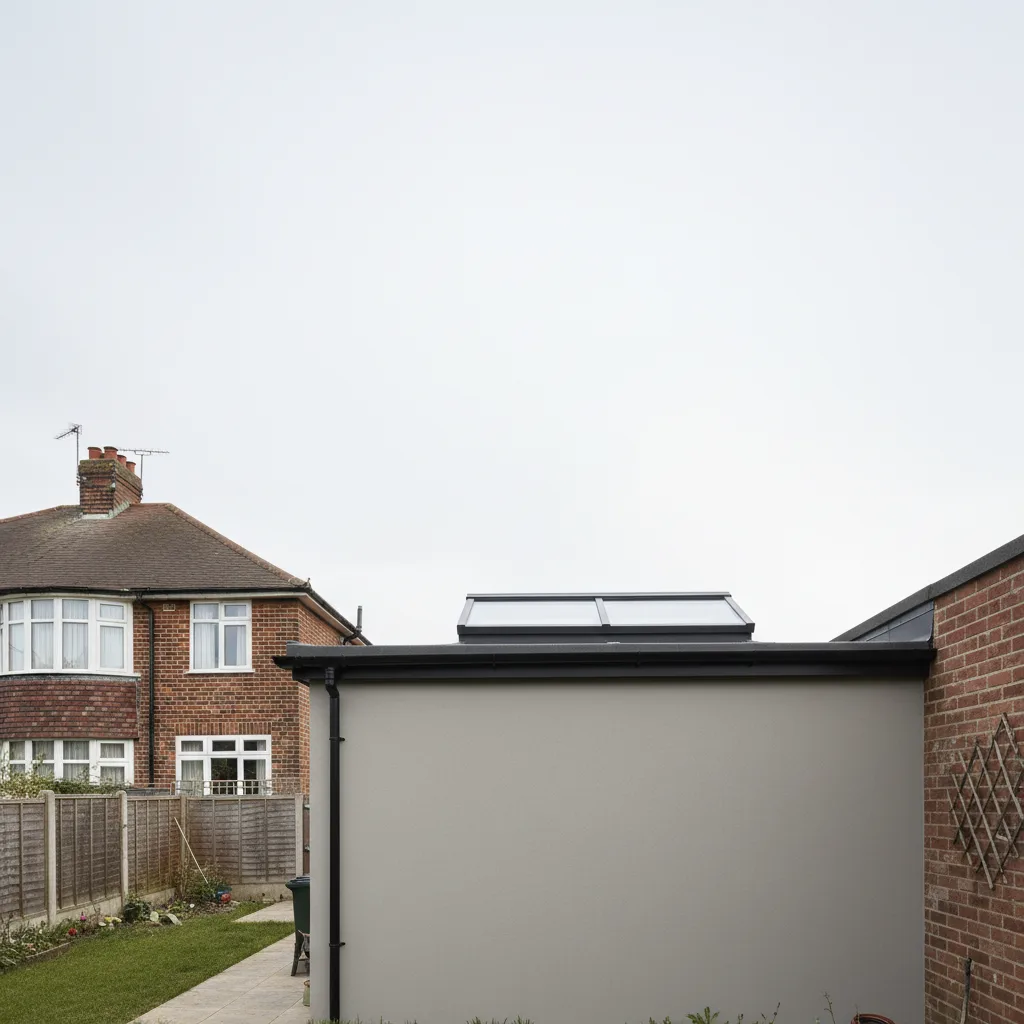
Orientation is what makes this local. Southend-on-Sea faces south across the Thames Estuary, so a great many rear extensions and loft conversions across Westcliff, Thorpe Bay and the 1930s semis inland point their new glass at the sun for most of the cooling season. There is an open southern horizon off the water and reflected light coming back up from the estuary on top of it. Put clear glass in a south-facing flat roof over a kitchen and no internal blind will save that room in summer. Get the glass right for the orientation and the blind goes back to doing the one thing it is good at, which is glare. That order, orientation first and glazing second, is the whole basis of our energy-efficient skylight installation work, and it is why we ask which way a roof faces before we talk about anything you hang below it.
A flat roof is the hardest case. Horizontal glazing looks almost straight up at the high summer sun, so orientation barely helps and the G-value has to carry the load. On those roofs an opening unit at the highest point, which lets the hottest air escape, will do more than any blind fitted below it. Pairing a low G-value pane with a way for hot air to leave beats reaching for a heavier blind every time.
What to do next
Start by naming the problem honestly. If the room is too bright, a blind is the right buy, and an internal one will do. If the room is too hot, a blind is at best a partial help and an external awning is the only version worth the money, while the real answer is the glass. If it is both, specify solar-control glazing for the heat and add a blackout blind for the glare, and you will not need to fight the sun with fabric alone.
If your skylight is already in and the room bakes, the moment the unit is due for replacement is the moment to change the glass specification, because the opening is already there and the only variable left is what goes into it. If you would like us to look at the orientation and tell you the G-value the roof needs before you spend anything on blinds, ring 01702 898232 or request a quote, and take a look at our guides on solar control while you decide.
Related reading
G-value explained, and why it matters more than U-value here
G-value explained, and why it matters more than U-value here. What it means in practice on Essex housing stock, and…
What is a good G-value for a skylight?
What is a good G-value for a skylight? The short answer, then the detail that actually matters.
Solar control glazing for south-facing roofs
Solar control glazing for south-facing roofs. What it means in practice on Essex housing stock, and how we approach it.
What U-value does a rooflight need for building regulations?
What U-value does a rooflight need for building regulations? The short answer, then the detail that actually matters.
Do skylights make a room too hot?
Do skylights make a room too hot? The short answer, then the detail that actually matters.
U-values, Part L and rooflight compliance
U-values, Part L and rooflight compliance. What it means in practice on Essex housing stock, and how we approach it.