Rooflight orientation and the estuary sun path
Rooflight orientation and the estuary sun path. What it means in practice on Essex housing stock, and how we approach it.
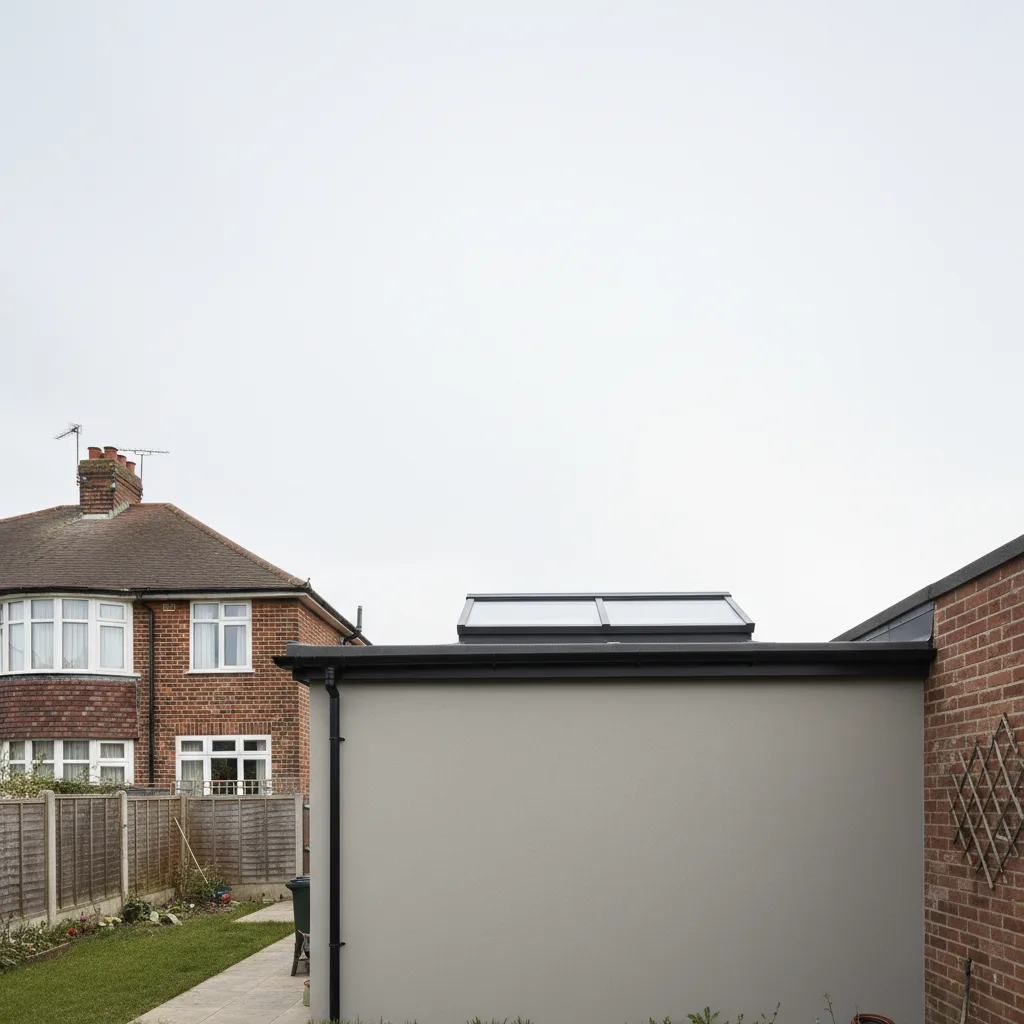
A rooflight cannot be moved once it is in. It looks at whatever slice of sky sits above that roof plane, all day, every day, for the next thirty years. So before anyone talks about frames or flashings, the question worth answering is a simple one: where does the sun actually travel over your roof, and which way is that plane pointing when it gets there? Southend answers that question differently from almost anywhere else on the English coast, because here the sun comes up out of the estuary and swings across the front of the house rather than behind it.
How the sun crosses the estuary through a single day
Start with one clear day in the middle of summer. Over south Essex the sun rises in the north-east, well to the left of due east, at about half past four in the morning. It climbs across the southern half of the sky, reaches its highest point due south a little after one in the afternoon by the clock, then sinks away into the north-west and sets close to nine at night. For most of that long arc it is sitting in the southern sky, which is exactly the half of the sky a Southend roof faces out over the water.
That is the part people rarely picture correctly. We think of the sun as an east-to-west traveller, and it is, but at this latitude it does the vast bulk of its work in the south. A roof plane that points south is looking straight at the sun’s path for hours at a stretch. A plane that points north spends the whole day looking at the opposite, empty quarter of the sky and only catches the sun for a short spell at either end of a summer day, low and glancing.
Now shrink the day down to winter. In late December the sun barely clears the rooftops. It comes up in the south-east around eight, drags itself along a shallow low path that never rises far above the estuary horizon, and drops back down in the south-west by four. The whole journey happens in the southern sky, close to the ground, in less than eight hours of daylight. A south-facing plane still sees all of it. Everything else sees almost none.
Reading the sun path across the year, in numbers
Two measurements describe where the sun is at any moment. Altitude is how high it stands above the horizon, from 0 degrees at the skyline to 90 degrees straight overhead. Azimuth is the compass direction it sits in, measured clockwise from north, so 90 is due east, 180 is due south, 270 is due west. Southend sits at roughly 51.5 degrees north, and at that latitude the year plays out like this.
| Date | Sunrise direction | Noon altitude | Sunset direction | Daylight hours |
|---|---|---|---|---|
| Midsummer, late June | North-east, azimuth ~50° | ~62° | North-west, azimuth ~310° | ~16.5 |
| Equinox, late Mar and Sep | Due east, azimuth ~90° | ~38° | Due west, azimuth ~270° | ~12 |
| Midwinter, late Dec | South-east, azimuth ~130° | ~15° | South-west, azimuth ~230° | ~7.75 |
Read the noon altitude column first. The midday sun swings through a full 47 degrees between the shortest and longest days, from a high, near-overhead 62 in June to a low, weak 15 in December. That single range explains why a flat rooflight and a steep south-facing pitch behave so differently across the seasons, and it is the reason orientation and pitch have to be considered together rather than one at a time.
Then read the sunrise and sunset columns. The points where the sun clears and leaves the horizon slide right across the compass through the year, a spread of about 80 degrees at each end. In June the sun actually rises and sets behind a north-facing roof for a short while, which is why even a north plane gets a little raw early and late light in high summer. In December it never strays out of the south. Any orientation decision that treats the sun as rising due east and setting due west is only correct on two days of the year.
Finding which way your roof plane actually faces
Orientation sounds obvious until you are standing under a loft hatch trying to work it out. Houses are rarely aligned neatly to the compass, and a roof usually has more than one plane pointing in more than one direction. Getting this right on paper before glass is ordered is the whole job.
The reliable method is the ridge line. Find the direction the ridge runs, then each roof slope faces at right angles to it. A ridge running roughly east to west gives you one slope facing broadly south and one facing broadly north. A ridge running north to south gives you an east slope and a west slope. On a hipped roof, or the complicated roofscape of a Victorian villa with bays and back additions, you can end up with three or four planes all pointing different ways, and each one is a separate decision.
A phone compass held flat against the slope, or simply noted at the ridge, settles it in a minute. What matters is not hitting an exact bearing but knowing which of four camps a plane sits in: broadly south, broadly north, broadly east or broadly west. A plane that faces south-west counts as south for these purposes, and one that faces south-east leans that way too. The estuary front of Southend means a great many rear extensions and loft slopes end up in the southern camp, because the gardens run down towards the water and the best roof aspect points the same way.
South-facing planes and the light off the water
A south-facing roof plane in Southend is in a stronger solar position than the same plane would be almost anywhere else on the coast. The reason is the aspect of the whole city. Most English seaside towns turn their backs to the sun and face out to a northern, eastern or western sea. Southend faces south, across open water, straight into the sun’s daily path. There is no cliff behind, no woodland, no taller ridge of buildings casting the roofs into afternoon shade. Along the front the land falls away to the estuary, so the horizon to the south is wide open from first light to last.
The water adds a second helping. A broad, flat estuary sitting directly to the south of a roof is a reflector. On a bright day it throws diffuse light upwards onto every south-facing slope along that stretch, on top of the direct beam the plane is already collecting. This part of Essex records some of the higher sunshine totals in the country, and a south-facing rooflight here is gathering light through more hours of more days than the same unit would inland or on a north-facing coast.
All of which is a gift in the depths of winter and a problem in the height of summer. The same plane that gives you free warmth and bright mornings in January is the one that turns a kitchen extension into a hotbox at four on a July afternoon. That is not a reason to avoid a south-facing rooflight. It is the reason to specify the glass for the aspect, choosing a lower solar factor so the plane keeps the daylight and sheds the heat. The physics of that trade, and the numbers behind it, are the whole subject of our work on energy-efficient skylight installation, and orientation is the survey step that comes before any of it.
East and west planes are a question of timing
The east and west camps get the same total dose of sun over a day, but at opposite ends of it, and the timing changes everything about how a room feels.
An east-facing plane collects its strongest light in the morning. The sun is climbing, the air and the fabric of the house are still cool from overnight, and the room has the whole rest of the day to lose whatever heat arrives. A bedroom or a breakfast room under an east slope wakes up bright and warms gently, and by the time the afternoon peak would be a nuisance the sun has long since moved round to the other side of the house. East is the forgiving orientation.
West is the one people misjudge. A west-facing plane sits in shadow all morning, so it feels innocent when you survey it at eleven o’clock, then it takes the full afternoon sun exactly when the day has already piled up its heat. The late sun is low, so it strikes a west-facing pitched slope close to square-on and pours in at a shallow angle right into the room at eye level. On a summer evening a west rooflight over a sitting room or a home office can be the hottest and most glaring aperture in the house between five and eight, well after a south plane has started to ease off. West often deserves the same low-solar-factor glass as south, and treating it as a mild middle option is a common and expensive mistake.
North-facing planes and the case for borrowed light
A north-facing roof plane almost never gets direct sun. Outside a brief spell at the extreme ends of a midsummer day, the sun is always in the opposite half of the sky, so a north plane lives entirely on diffuse light from the sky dome. That sounds like a drawback and it is exactly the opposite.
North light is the steady, even, glare-free light that studios and galleries are built to catch. It arrives without a beam to squint at, without a hot spot tracking across the floor, and without the afternoon build-up that comes with a southern aspect. A rooflight on a north plane can be given the clearest, most light-hungry glass on the market with no penalty, because there is no solar heat to control. If you have a choice of planes for a room that is used all day, a studio, a kitchen you cook in at all hours, an office with screens, the north slope is often the quiet winner. It gives you brightness you can live under without the temperature that usually rides in with it.
The one thing a north plane cannot offer is free winter warmth, since it never sees the low December sun. In a room that runs cold and is used mainly in the colder months, that trade may point you back towards a southern or eastern aspect instead. Orientation is always a decision about the room as much as the roof.
How pitch changes the orientation story
Orientation tells you which way a plane looks. Pitch tells you how steeply it tilts towards the sky, and the two together decide how the sun’s beam meets the glass. The flatter the plane, the more it behaves like a plane facing straight up, which in high summer means straight at the near-overhead sun.
A flat rooflight, the standard choice over a single-storey rear extension, faces the whole sky dome and takes the June sun almost head-on at midday, because that sun is up at 62 degrees and the glass is close to horizontal. In December the same flat unit sees the low 15-degree sun at a shallow, glancing angle and gathers very little from it. So a flat rooflight is a strong summer collector and a weak winter one, whichever way the building happens to point, and on a south-facing extension that summer strength is precisely what the glass specification has to answer for.
A pitched plane changes the balance. A slope of around 30 to 45 degrees facing south catches the winter sun far more squarely, so it delivers more of that welcome low-season warmth, while opening up its angle to the steep summer sun and easing the midsummer peak a little. This is why the orientation conversation and the pitch of your roof cannot be separated. The same south aspect behaves one way on a flat kitchen extension and another way on a steep Victorian loft slope, and the glass choice follows both.
| Plane | When the sun is on it | Typical instinct |
|---|---|---|
| Flat, any aspect | Strong at midsummer midday, weak in winter | Treat as a southern-strength plane for glass choice |
| South pitched | All day, all year, strongest in the middle | Lowest solar factor, glare and heat the priority |
| West pitched | Afternoon and evening, low and glaring | Same care as south, easy to underestimate |
| East pitched | Morning, gentle, room recovers all day | Moderate control, the forgiving aspect |
| North, any pitch | Diffuse light only, no direct beam | Clearest glass, chase the daylight |
Putting orientation to work on a south Essex roof
The housing across this patch makes orientation a live decision on most jobs rather than a formality. The 1930s semi belt, of which south Essex has an enormous stock, typically ends in a rear extension over a knocked-through kitchen and dining room, with the garden and its roof aspect running towards the estuary in a great many streets. That puts a flat or shallow-pitched south-facing plane over exactly the room the family lives in, which is why a roof lantern or a run of flat-roof skylights over that space needs its aspect worked out before the glass is chosen, not after.
Loft conversions in the Victorian and Edwardian terraces along the cliff, and in the seafront villa stock, often place a bedroom window into a south-facing slope with a clear run down to the water and nothing shading it above. Those slopes get the full southern arc and the estuary reflection together. The weatherboard and timber-frame houses out in the Rochford and Maldon villages sit at more varied angles to the compass, so there orientation genuinely has to be surveyed plane by plane rather than assumed.
The practical upshot is the same across all of it. A roof with both a south and a north plane should not carry the same glass in both. The north plane gets the clear, light-hungry unit; the south plane gets the solar-control one; and the two rooflights on one house end up specified differently on purpose. A pitched-roof skylight on a shaded northern slope and one on the sunny southern slope are answering two different questions about the same sky.
What to work out before you commit
You can settle the orientation of a job in a short survey, and it is worth insisting it happens before any glass is ordered. Here is the sequence that matters.
- Fix the aspect of every plane. Ridge direction, then compass check on each slope, sorted into the four camps: broadly south, north, east or west. A plane facing south-west counts as south; one facing south-east leans that way too.
- Note the pitch of each plane. Flat, shallow or steep changes how the sun meets the glass and shifts a flat plane towards southern-strength behaviour whichever way the house points.
- Check the horizon, not just the compass. A tall neighbour, a mature tree or a return wall can shade a plane for part of the day and change the sums. Along the Southend cliff and seafront the southern horizon is usually wide open, which strengthens the case for controlling the glass on those slopes.
- Match the room to the aspect. A bedroom that has to cool overnight, an office with screens, a kitchen with its own heat sources, all of these want a different answer from a cold winter sitting room or a bright north-lit studio.
- Specify the glass per plane. Once the aspect and the room are known, the solar factor and the U-value follow, and they can differ from one rooflight to the next on the same roof.
Every installation we carry out starts with that orientation survey, is fitted to current Building Regulations, and is covered by a ten-year workmanship guarantee, with the notification to Southend-on-Sea City Council or your relevant local authority made on your behalf as part of the job. If you want the aspect of your own roof read plane by plane before you commit to anything, ask us for a survey and a specification and we will tell you which way each slope looks and what the sun does to it across the year.
Related reading
G-value explained, and why it matters more than U-value here
G-value explained, and why it matters more than U-value here. What it means in practice on Essex housing stock, and…
What is a good G-value for a skylight?
What is a good G-value for a skylight? The short answer, then the detail that actually matters.
Solar control glazing for south-facing roofs
Solar control glazing for south-facing roofs. What it means in practice on Essex housing stock, and how we approach it.
What U-value does a rooflight need for building regulations?
What U-value does a rooflight need for building regulations? The short answer, then the detail that actually matters.
Do skylights make a room too hot?
Do skylights make a room too hot? The short answer, then the detail that actually matters.
U-values, Part L and rooflight compliance
U-values, Part L and rooflight compliance. What it means in practice on Essex housing stock, and how we approach it.